
Datasets
All benchmark data lives in the
Calibench Hugging Face organization.
The calibench-vi/datasets
repository is the source of truth: it hosts our own VI-Rig captures
(CC-BY-4.0) and ships download recipes for the third-party datasets the
benchmark evaluates against. The Google Drive links from the legacy site are
retired.
Hosted — VI-Rig captures
Section titled “Hosted — VI-Rig captures”Collected on a self-built VI-Rig for research on multi-visual-inertial
calibration. Reference Kalibr and MVIS results for these captures are published
in calibench-vi/results.
| Dataset | Sensors | Sequences | Data |
|---|---|---|---|
| 4 IMUs + 3 cameras | 4 IMUs, 3 global-shutter | 10 AprilGrid | virig-4imus-3cams |
| 4 IMUs + 3 cameras — ArUco | same rig, ArUco-tag sequences | 17 | virig-4imus-3cams-aruco |
| 4 IMUs + 4 cameras | 4 IMUs, 2 GS + 2 rolling shutter | 15 AprilGrid (+7 raw) | virig-4imus-4cams |
| 5 IMUs + 4 cameras | 5 IMUs (two T265 stereo fisheye pairs), 4 cameras | 7 AprilGrid | virig-5imus-4cams |
Third-party datasets (recipes)
Section titled “Third-party datasets (recipes)”Calibench hosts only data we own; every third-party dataset the benchmark
evaluates ships as a download.py recipe (manifest + checksums) that pulls it
from its original host — EuRoC MAV, TUM VI, TUM RGB-D, TUM VIE, TUM
Double-Sphere, TUM RS, Monado MSD, Hilti 2022, Hilti 2023 Handheld,
PennCOSYVIO, and an urban fisheye set. See
recipes/
and its
SOURCES.md
for the exact list and licenses. The leaderboard
evaluates calibration methods across these datasets plus the hosted VI-Rig
captures.
Datasets with complete MVIS runs documented as worked examples on this site:
| Dataset | Rig | Example |
|---|---|---|
| TUM VI | Stereo 1024² fisheye + BMI160 | TUM VI |
| TUM MIC (Monado / Valve Index) | Stereo fisheye + IMU | Monado |
| looperrobotics SA16 | 2–3 cameras + 400 Hz IMU | Looper SA16 |
Contributing one: Submit a dataset.
Citation
Section titled “Citation”If you use the Calibench data, please cite the benchmark, and the MVIS paper for the VI-Rig captures:
@misc{calibench2026, title = {Calibench: Calibration Benchmark Datasets}, author = {Yang, Yulin}, year = {2026}, howpublished = {\url{https://huggingface.co/datasets/calibench-vi/datasets}}}@article{yang2024mvis, title = {Multi-visual-inertial system: Analysis, calibration, and estimation}, author = {Yang, Yulin and Geneva, Patrick and Huang, Guoquan}, journal = {The International Journal of Robotics Research}, year = {2024}, doi = {10.1177/02783649241245726}}Third-party datasets keep their own licenses and citations — the dataset card maps each config to its required upstream citation.
VI-Rig sensors
Section titled “VI-Rig sensors”We use a self-built VI-Rig to collect data. The rig contains 4 IMUs, one monocular camera, and 2 stereo pairs. Treating each stereo camera as two monocular cameras, we have 5 cameras total.
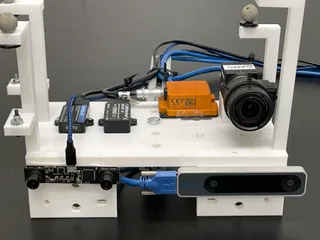
Visual-Inertial (VI)-Rig — 4 IMUs and 5 cameras:
- MicroStrain GX3-25
- MicroStrain GX3-35
- Xsens MTI-100
- RealSense T265 IMU
- FLIR BlackFly
- RealSense T265 Left & Right cameras
- ELP Left & Right rolling-shutter cameras
ROS drivers can be found here.
Dataset info
Section titled “Dataset info”The datasets contain the following ROS topics:
| Sensor | Hz | Topic | Resolution |
|---|---|---|---|
| MicroStrain GX3-25 | 500 | /gx3_25/data | — |
| MicroStrain GX3-35 | 100 | /gx3_35/imu/data | — |
| Xsens MTI-100 | 400 | /imu/data | — |
| RealSense T265 IMU | 200 | /t265/imu | — |
| FLIR BlackFly | 30 | /blackfly/image_raw | 720×540 |
| RealSense T265 Left | 30 | /t265/fisheye1/image_raw | 848×800 |
| RealSense T265 Right | 30 | /t265/fisheye2/image_raw | 848×800 |
| ELP Left rolling shutter | 25 | /elp/split_sync_image_node/left/image_raw | 640×480 |
| ELP Right rolling shutter | 25 | /elp/split_sync_image_node/right/image_raw | 640×480 |