
Intel RealSense T265
Tracking camera: global-shutter fisheye stereo with a Bosch BMI055 IMU
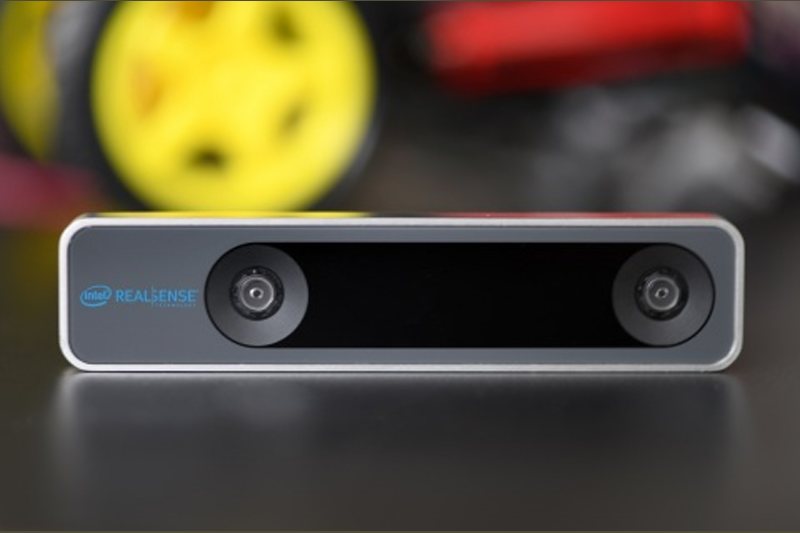
- Cameras
- 848 × 800 fisheye stereoMaker ↗︎
- Shutter
- GlobalCatalog
- Field of view
- Calibrated past the fitMeasured
163° diagonalMaker ↗︎ - Baseline
- 63.8 mmMeasured
- IMU
- BMI055, gyro 200 Hz, accel 62.5 HzMeasured
- Output
- USB 3Maker ↗︎
Maker values checked 2026-11-03; Intel lists it as discontinued · 1 recording · CC BY-NC 4.0 · ~ marks a value read past where the board corners reached. Past the fit: the edge lies beyond where the lens fit holds, so we give no value.
Demo and values
Section titled “Demo and values”Tracking camera from Intel with two global-shutter fisheye cameras and a Bosch BMI055 IMU, solved here on its own IMU from one recording of our VI-Rig.
Reprojection is how far, in pixels, the detected corners lie from where the solve puts them. td is the camera–IMU time offset, and the lever arm is the camera–IMU position offset.
One recording, with no independent reference on this page. These values show what MVIS solved, not how close they are to the truth.
Calibration process
Section titled “Calibration process”The path of the rig around the board, as MVIS solved it. To explore it:
- Press Play or drag the bar to follow the path.
- Use the view buttons to change the view.
- Pick a camera card to put that camera on the frustum, the pyramid that shows its view.
Each card draws the board from the solved pose, with the corners MVIS detected. We publish no camera images.
Solved rig
Section titled “Solved rig”The solved rig in 3D, to scale. Tap a sensor to see its values. In full screen you can rotate and zoom. Grid squares are 20 mm.
To scale, from above and the front
Dashed: past the fit, drawn to the corners' reach, so the lens sees at least this much.
| Camera | Lever x, y, z (mm) | Distance (mm) | log(R) (rad) | td (ms) | Field of view |
|---|---|---|---|---|---|
| cam0 | +11.7, +4.3, +8.4 | 15.0 | [+0.017, −0.000, −3.127] | −7.99 | past the fit |
| cam1 | −52.1, +4.1, +7.5 | 52.8 | [+0.027, −0.005, −3.126] | −10.65 | past the fit |
Solved by MVIS. Lever arms (camera–IMU position offsets) are in the IMU frame. Rotation is log(R), camera in the IMU frame.
Specifications
Section titled “Specifications”| Published by the maker | |
|---|---|
| Cameras | 2 × OV9282, 848×800 at 30 Hz |
| Shutter | Global |
| Lens | Fisheye, about 163° |
| Measured in these recordings | |
| IMU | Bosch BMI055, gyro at 200 Hz, accel at 62.5 Hz |
| Calibrated field of view | cam0 past the fit · cam1 past the fit |
Dataset
Section titled “Dataset”| Recording | VI-Rig, recording 1, 80 s window chosen by motion |
| Format | ROS bag |
| Board | AprilGrid 6×6, tag 88 mm, spacing 0.3, t36h11 |
| Configs and results | Calibench community, intel-t265/ (access by automatic approval) |
| Licence | CC BY-NC 4.0, for the data and for this page's clip and figures; commercial use by request |
| Hosted | Calibench, virig-4imus-3cams/ (access by automatic approval) |
Detailed results
Section titled “Detailed results”Lens Calibrated field of view
Calibrated field of view, horizontal × vertical. cam0: past the fit, corners reach 70° from the axis · cam1: past the fit, corners reach 69° from the axis
cam0 cam1
We read these from the calibrated lens fit at the image edges, through the principal point (where the optical axis meets the image). ~ marks an axis past where the corners reached, so the fit is extrapolated there. Past the fit means an edge lies beyond where the fit holds, so we give no value.
IMU Gyro–accel time offset t_ga −6.59 ms
Each bar shows a scale as its deviation from 1. IMU model: calyx. t_ga, the time offset between the gyroscope and accelerometer channels: −6.59 ± 0.43 ms.
Timing cam0 td −7.99 ms
The time offsets, to scale. td is the camera–IMU time offset, with t_imu = t_cam + td.
Full results Every solved parameter
Rotation is log(R) in rad, camera in the IMU frame.
| Parameter | MVIS |
|---|---|
| cam0 | |
| fx px | 286.44 |
| fy px | 285.86 |
| cx px | 415.36 |
| cy px | 403.21 |
| k1 | −0.00258 |
| k2 | 0.03660 |
| k3 | −0.03556 |
| k4 | 0.00595 |
| Lever x mm | +11.69 |
| Lever y mm | +4.33 |
| Lever z mm | +8.41 |
| log(R) rad | [+0.0173, −0.0003, −3.1271] |
| td ms | −7.992 |
| Reprojection px | 0.415 |
| cam1 | |
| fx px | 286.30 |
| fy px | 285.56 |
| cx px | 414.91 |
| cy px | 397.49 |
| k1 | −0.00356 |
| k2 | 0.03876 |
| k3 | −0.03782 |
| k4 | 0.00702 |
| Lever x mm | −52.15 |
| Lever y mm | +4.07 |
| Lever z mm | +7.52 |
| log(R) rad | [+0.0268, −0.0045, −3.1260] |
| td ms | −10.649 |
| Reprojection px | 0.406 |
| IMU | |
| t_ga ms | −6.59 ± 0.43 |
Limits
Section titled “Limits”- One recording, with no independent reference on this page. These values show what MVIS solved, not how close they are to the truth.
- The T265 gyro-to-accel offset isn't a pure time shift. We measured about −6.8 ms at 2–4 Hz and −1.2 ms at 30–40 Hz, so a single t_ga is a compromise that depends on the motion.
How it was run
Section titled “How it was run”- Fisheye stereo plus the T265's own IMU, camera intrinsics free, t_ga estimated. Batch of 2026-11-03.