
VI-Rig — 4 IMUs + 4 cameras
Two global-shutter and two rolling-shutter cameras with four IMUs on one frame, recorded in front of an AprilGrid. The guides use this set as their running example, because it has every hard case in one rig: fisheye lenses, rolling shutter, several cameras and several IMUs.
- Hub folder:
calibench-vi/datasets→virig-4imus-4cams - Licence: CC BY-NC 4.0, gated; commercial use on request. See Licence and access.
- Results: benchmark results · worked example
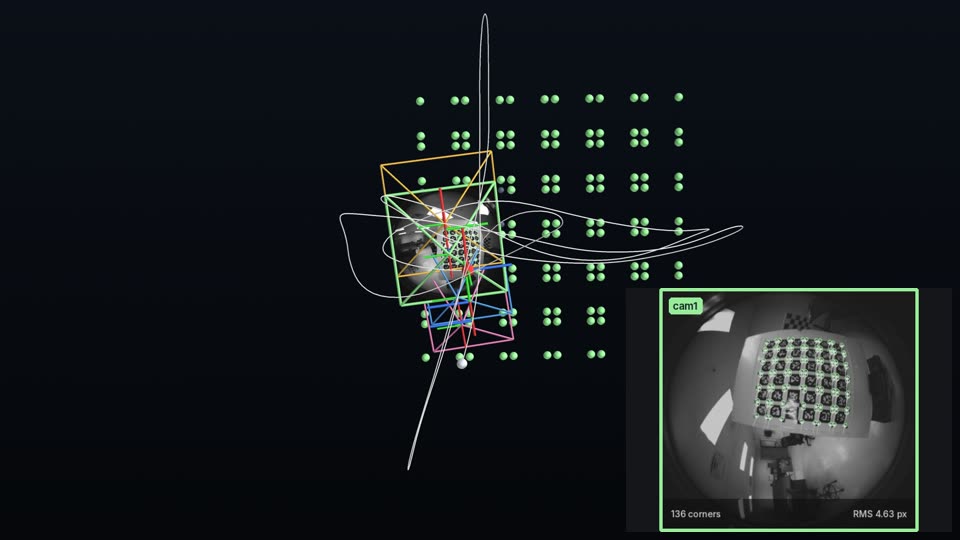
The rig
Section titled “The rig”The same frame as in 4 IMUs + 3 cameras, with an ELP stereo module in place of the Blackfly. Rates are measured from the bags.
| Sensor | Type | Shutter | Rate | Image size | ROS topic |
|---|---|---|---|---|---|
| RealSense T265, left | camera, fisheye (about 163°) | global | 30 Hz | 848×800 | /t265/fisheye1/image_raw |
| RealSense T265, right | camera, fisheye (about 163°) | global | 30 Hz | 848×800 | /t265/fisheye2/image_raw |
| ELP stereo, left | camera, standard lens | rolling | 25 Hz as recorded, about 20–22 Hz after restamping | 640×480 | /elp/split_sync_image_node/left/image_raw |
| ELP stereo, right | camera, standard lens | rolling | 25 Hz as recorded, about 20–22 Hz after restamping | 640×480 | /elp/split_sync_image_node/right/image_raw |
| Xsens MTi-100 | IMU | – | 400 Hz | – | /imu/data |
| MicroStrain 3DM-GX3-25 | IMU | – | 500 Hz | – | /gx3_25/data |
| MicroStrain 3DM-GX3-35 | IMU | – | 100 Hz | – | /gx3_35/imu/data |
| RealSense T265 IMU (BMI055) | IMU | – | 200 Hz | – | /t265/imu |
- Board: AprilGrid, 6×6 tags of family t36h11, tag size 88 mm, spacing 0.3 of the tag size. The target file
april.yamlis in the folder. - Board shape: the printed board is not flat (about 2.4 mm rms). Our runs estimate its shape; see Why calibrate the board shape.
- More on the T265: device page.
Recordings
Section titled “Recordings”- Count: 15 ROS1 bags,
4imus_4cams_01.bagto4imus_4cams_15.bag. - Length: 131 to 152 s each, 35 minutes in total.
- Size: 7.1 to 8.3 GB each, 113 GB in total.
The ELP stamps in the bags as recorded are the times the computer received each frame, not when the camera took it. Both ELP cameras run on one shared frame clock (about 29.6 Hz), and the driver delivers about 25 of those frames per second. So each recording comes in two versions:
4imus_4cams_NN.bag(restamped, for board calibration): each ELP frame is moved onto the camera’s own frame clock, the same for both ELP cameras. The fit uses the board detections, so the tool removes the frames it cannot place: fit outliers, frames with no board detection and frames outside the solved window. About 20 to 22 frames per second are left. A.sensor_clock_provenance.yamlbeside each bag records the fit and the frames removed. Our benchmark runs use these bags.4imus_4cams_NN_raw.bag(as recorded): every frame, with the original ELP stamps. Use it for anything other than board calibration.
Download
Section titled “Download”Accept the terms on the Hub page and set
HF_TOKEN to a read token from your Hugging Face settings (or run hf auth login once,
after pip install huggingface_hub). Then either:
# with MVIS: checks size and SHA-256, saves to $MVIS_DATASETS/mvis_4imus_4cams/mvis datasets list --dataset mvis_4imus_4camsmvis datasets download --select mvis_4imus_4cams/bag_01 # one recording, 8.1 GBmvis datasets download --dataset mvis_4imus_4cams # all 15, 113 GB# with the Hugging Face CLI: the 15 restamped recordings, their provenance files and the board filehf download calibench-vi/datasets --repo-type dataset \ --include "virig-4imus-4cams/4imus_4cams_??.bag*" "virig-4imus-4cams/april.yaml" \ --local-dir ./calibenchmvis datasets fetches the restamped bags only. Add "virig-4imus-4cams/*_raw.bag" to the hf command for the
raw ones.
Results
Section titled “Results”We ran MVIS and Kalibr on every recording, and Basalt on the camera-only runs (batch 2026-11-10a). The results page shows every value and its spread.
| Run | Recordings solved |
|---|---|
| Camera only, T265 pair | MVIS 15 of 15 · Kalibr 15 of 15 · Basalt 15 of 15 |
| Camera only, ELP pair with readout time | MVIS 15 of 15 · Kalibr 15 of 15 on ELP left, 13 of 15 on ELP right, one camera at a time · Basalt 15 of 15 as global shutter, no readout time (shown only) |
| Camera + IMU, T265 left + ELP left, T265 IMU + Xsens | MVIS 15 of 15 · Kalibr 14 of 15 · Basalt not run (one IMU per run, no rolling-shutter model) |
| Camera + IMU, ELP pair, T265 IMU + Xsens | MVIS 15 of 15 · Kalibr 3 of 15, from earlier runs · Basalt not run (no rolling-shutter model) |
A few MVIS values. Each is the median over the 15 recordings, ± the standard deviation between recordings. This shows how well MVIS repeats, not that it is right.
- T265 stereo baseline (camera only): 63.667 ± 0.036 mm
- ELP stereo baseline (camera + IMU, ELP pair): 59.21 ± 0.08 mm
- ELP readout time (camera + IMU, ELP pair): 16.6 ± 0.1 ms. The readout time is how long the camera takes to read the image from the first row to the last. The camera-only runs give 14.6 ± 0.4 ms; the results page shows both.
- Reprojection error, median (camera + IMU, ELP pair): 0.16 px (left), 0.18 px (right)
The worked example shows one full run with its config.
How we ran Kalibr on the rolling-shutter ELP cameras (stock Kalibr, Docker image kalibr:noetic):
- Camera only:
kalibr_calibrate_rs_cameras, one ELP camera at a time, so it gives no ELP stereo baseline. These runs predate the ELP restamping. - Camera + IMU: Kalibr’s camera + IMU solver is global-shutter only, so its runs treat ELP left as a global-shutter camera with readout time 0.
See Methodology for how the tools are compared.
Sensor order in the results files
Section titled “Sensor order in the results files”The reference results in calibench-vi/results hold one
file per tool, batch and run (for example MVIS/2026-11-10a/T8.json) and the configs behind them in
configs/<run>/. Each run names its own sensors; Kalibr and MVIS use the same order. The base IMU is the one the
other sensors are referred to. The GX3-25 and GX3-35 are in the bags but in none of these runs.
| Run (folder) | Cameras | IMUs |
|---|---|---|
Camera only, T265 pair (T1) | cam0 T265 left, cam1 T265 right | – |
Camera only, ELP pair (T2) | MVIS: cam0 ELP left, cam1 ELP right. Kalibr: one ELP camera per run | – |
Camera + IMU, T265 left + ELP left (T7) | cam0 T265 left, cam1 ELP left | imu0 / base: T265 IMU, imu1 / aux: Xsens MTi-100 |
Camera + IMU, ELP pair (T8) | MVIS: cam0 ELP left, cam1 ELP right. Kalibr (earlier runs of recordings 1–3): cam0 T265 left | imu0 / base: T265 IMU, imu1 / aux: Xsens MTi-100 |
Run it yourself
Section titled “Run it yourself”- Start here: the worked example has the camera + IMU config we ran.
- Step by step: the guides walk through this set, from Camera-only calibration and Rolling shutter to Camera–IMU calibration and Multi-IMU calibration.
- Why it matters: rolling shutter, several cameras and several IMUs are each shown on this set.
Please cite Calibench and the MVIS paper. The BibTeX is on the overview page.