
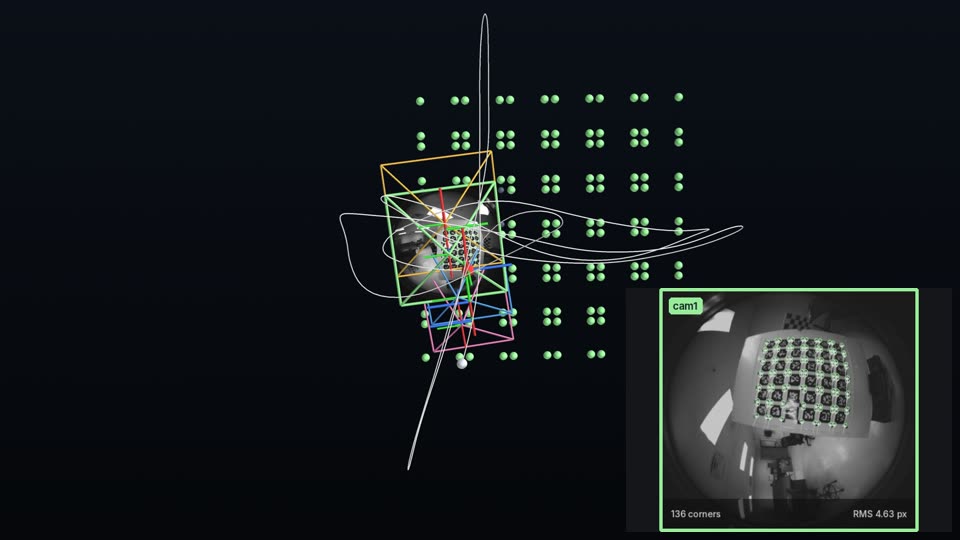
VI-Rig: 4 IMUs + 4 cameras
Repeatability, not accuracy. There is no ground truth: a small spread shows that a tool repeats, not that it is right, and a difference shows that two tools disagree, not which one is wrong. The MVIS authors made every run, including Kalibr and Basalt.
Repeatability
Section titled “Repeatability”| Family | Focal + pp px | Distortion | Distance mm | Readout ms | Time offset ms | Cam–IMU distance mm | Gyro | Accel |
|---|---|---|---|---|---|---|---|---|
| T1 · camera n = 15 matched t265 GS fisheye stereo | MVIS ×1.6 a | MVIS ×1.6 ba | Not separated a | — | — | — | — | — |
| T2 · camera n = 13 matched ELP RS stereo + readout | not compared | not compared | not compared | MVIS ×4.2 | — | — | — | — |
| T7 · cam+IMU n = 14 matched Mixed t265-f1 + ELP-L, aux Xsens | input, not compared | input, not compared | input, not compared | input, not compared | Tie cdefg | MVIS ×7.6 cdef | MVIS ×2.9K-IMU cdfh | MVIS ×4.4K-IMU cdfh |
| T8 · cam+IMU n = 3 matched ELP RS stereo + two IMUs (IMUs only) | MVIS only | MVIS only | MVIS only | MVIS only | n = 3 · too few cg | n = 3 · too few c | n = 3 · too few ch | n = 3 · too few ch |
T1 · camera · t265 GS fisheye stereo More repeatable or tie: Focal + pp MVIS · Distortion MVIS · Distance not separated n = 15 matched · MVIS 15 of 15 · Kalibr 15 of 15 · Basalt 15 of 15
T2 · camera · ELP RS stereo + readout More repeatable or tie: Readout MVIS n = 13 matched · MVIS 15 of 15 · Kalibr 15 of 15 · Basalt 15 of 15
- Readout MVIS×4.2
- Focal + pp · Distortion · Distance: not compared
T7 · cam+IMU · Mixed t265-f1 + ELP-L, aux Xsens More repeatable or tie: Time offset tie · Cam–IMU distance MVIS · Gyro MVIS K-IMU · Accel MVIS K-IMU n = 14 matched · MVIS 15 of 15 · Kalibr 14 of 15 · Basalt not run
T8 · cam+IMU · ELP RS stereo + two IMUs (IMUs only) Too few recordings (n = 3) n = 3 matched · MVIS 15 of 15 · Kalibr 3 of 15 · Basalt not run
MVIS Kalibr Basalt tool ×k more repeatable: the other tools' typical scatter is k times larger Tie gap within chance or under 20 % too few under 6 shared recordings input no comparison, reason in the cell K-IMU MVIS run with Kalibr's IMU model
k = the looser tool's typical scatter divided by the tighter tool's (median over the group's parameters, on the recordings every compared tool ran). Click a cell for its numbers.
- a Basalt's fisheye-2 frames are snapped onto fisheye-1 (1.8–5 ms apart).
- b Coefficients trade off against each other, so their scatter can overstate differences in the lens mapping.
- c Data settings still differ between the tools on this family.
- d Kalibr starts from MVIS camera values for each recording; its spread here includes the spread of that input.
- e Kalibr ran ELP-L as a global-shutter camera with its stamps shifted by the MVIS td of each recording, so the ELP-L rows are left out here.
- f Kalibr's t265 fisheye 1 intrinsics came from an older MVIS export.
- g MVIS also fits a gyro–accel delay (t_ga) that Kalibr and Basalt do not, so its td is not quite the same quantity.
- h MVIS here uses Kalibr's IMU model, so the gyro and accel terms mean the same thing in both tools.
Each cell is a separate comparison on the recordings every compared tool ran. Cells are not added up and nothing is ordered across datasets.
Not part of this comparison
- T2 distortion coefficients of ELP-L (4 rows): other camera model: MVIS equidistant, Kalibr and Basalt radtan
- T2 distortion coefficients of ELP-R (4 rows): other camera model: MVIS equidistant, Kalibr and Basalt radtan
- T7 reprojection error (2 rows): fit quality, not repeatability and not accuracy
- T7 IMU g-sensitivity Tg (18 rows): Kalibr absorbs it in its IMU model
- T7 gyro–accel delay t_ga (2 rows): MVIS only
- T8 focal length + principal point of ELP-L (4 rows): no Kalibr rolling-shutter run
- T8 distortion coefficients of ELP-L (4 rows): no Kalibr rolling-shutter run
- T8 rolling-shutter readout of ELP-L (1 row): no Kalibr rolling-shutter run
- T8 camera–imu time offset of ELP-L (1 row): no Kalibr rolling-shutter run
- T8 camera–imu distance of ELP-L (1 row): no Kalibr rolling-shutter run
- T8 reproj median of ELP-L (1 row): no Kalibr rolling-shutter run
- T8 focal length + principal point of ELP-R (4 rows): no Kalibr rolling-shutter run
- T8 distortion coefficients of ELP-R (4 rows): no Kalibr rolling-shutter run
- T8 rolling-shutter readout of ELP-R (1 row): no Kalibr rolling-shutter run
- T8 camera–camera distance of ELP-R (1 row): no Kalibr rolling-shutter run
- T8 camera–imu time offset of ELP-R (1 row): no Kalibr rolling-shutter run
- T8 camera–imu distance of ELP-R (1 row): no Kalibr rolling-shutter run
- T8 reproj median of ELP-R (1 row): no Kalibr rolling-shutter run
- T8 IMU g-sensitivity Tg (18 rows): Kalibr absorbs it in its IMU model
- T8 gyro–accel delay t_ga (2 rows): MVIS only
- T7 Basalt: not run: one IMU per run and no rolling-shutter model; no run holds the whole rig
- T8 Basalt: not run: no rolling-shutter model
Focal length + principal point · T1 · 15 matched recordings (MVIS 15 of 15 · Kalibr 15 of 15 · Basalt 15 of 15) · t265 GS fisheye stereo, camera
Across the same 15 recordings, Kalibr's estimates scatter about 3.2× more than MVIS's (median over 8 parameters); Basalt's about 1.6×. A gap this large appeared in 0.049 % (Kalibr) and 0.0061 % (Basalt) of recording-by-recording swaps. Holds with any one recording left out.
MVIS here: its camera-only run.
| Pair | R | 95 % interval | p (Holm) | Decision | Leave one out |
|---|---|---|---|---|---|
| MVIS ÷ Kalibr · 8 param. | 0.31 | 0.15 – 0.5 | 0.00098 (raw 0.00049) | MVIS tighter | holds with any one recording left out |
| MVIS ÷ Basalt · 8 param. | 0.62 | 0.36 – 0.83 | 0.00018 (raw 0.000061) | MVIS tighter | holds with any one recording left out |
| Kalibr ÷ Basalt · 8 param. | 1.87 | 1.18 – 2.92 | 0.0055 | Basalt tighter | holds with any one recording left out |
The 95 % interval of MVIS ÷ Basalt reaches into the tie band (0.80–1.25): the ratio shown is a point value.
The 95 % interval of Kalibr ÷ Basalt reaches into the tie band (0.80–1.25): the ratio shown is a point value.
| Parameter | MVIS sd | Kalibr sd | Basalt sd |
|---|---|---|---|
| t265 fisheye 1 · fx px | 0.646 | 2.4 | 0.65 |
| t265 fisheye 1 · fy px | 0.722 | 2.59 | 0.791 |
| t265 fisheye 1 · cx px | 0.253 | 0.652 | 0.677 |
| t265 fisheye 1 · cy px | 0.336 | 0.849 | 0.799 |
| t265 fisheye 2 · fx px | 0.63 | 2.42 | 0.593 |
| t265 fisheye 2 · fy px | 0.707 | 2.57 | 0.746 |
| t265 fisheye 2 · cx px | 0.234 | 0.669 | 0.646 |
| t265 fisheye 2 · cy px | 0.329 | 0.839 | 0.784 |
- a Basalt's fisheye-2 frames are snapped onto fisheye-1 (1.8–5 ms apart).
Repeatability only — a tool can repeat well and still be biased.
Distortion coefficients · T1 · 15 matched recordings (MVIS 15 of 15 · Kalibr 15 of 15 · Basalt 15 of 15) · t265 GS fisheye stereo, camera
Across the same 15 recordings, Kalibr's estimates scatter about 34× more than MVIS's (median over 8 parameters); Basalt's about 1.6×. A gap this large appeared in 0.0061 % (Kalibr) and 2.3 % (Basalt) of recording-by-recording swaps. Holds with any one recording left out.
MVIS here: its camera-only run.
| Pair | R | 95 % interval | p (Holm) | Decision | Leave one out |
|---|---|---|---|---|---|
| MVIS ÷ Kalibr · 8 param. | 0.03 | 0.01 – 0.11 | 0.00018 (raw 0.000061) | MVIS tighter | holds with any one recording left out |
| MVIS ÷ Basalt · 8 param. | 0.61 | 0.4 – 0.91 | 0.023 | MVIS tighter | holds with any one recording left out |
| Kalibr ÷ Basalt · 8 param. | 19.97 | 5.54 – 38.03 | 0.00018 (raw 0.000061) | Basalt tighter | holds with any one recording left out |
The 95 % interval of MVIS ÷ Basalt reaches into the tie band (0.80–1.25): the ratio shown is a point value.
| Parameter | MVIS sd | Kalibr sd | Basalt sd |
|---|---|---|---|
| t265 fisheye 1 · dist k1 | 0.00199 | 0.0482 | 0.00332 |
| t265 fisheye 1 · dist k2 | 0.00337 | 0.127 | 0.00651 |
| t265 fisheye 1 · dist k3 | 0.00416 | 0.13 | 0.00637 |
| t265 fisheye 1 · dist k4 | 0.00157 | 0.0441 | 0.00198 |
| t265 fisheye 2 · dist k1 | 0.00211 | 0.0535 | 0.00325 |
| t265 fisheye 2 · dist k2 | 0.00336 | 0.158 | 0.00889 |
| t265 fisheye 2 · dist k3 | 0.00403 | 0.181 | 0.00823 |
| t265 fisheye 2 · dist k4 | 0.00155 | 0.0691 | 0.0025 |
- b Coefficients trade off against each other, so their scatter can overstate differences in the lens mapping.
- a Basalt's fisheye-2 frames are snapped onto fisheye-1 (1.8–5 ms apart).
Repeatability only — a tool can repeat well and still be biased.
Camera–camera distance · T1 · 15 matched recordings (MVIS 15 of 15 · Kalibr 15 of 15 · Basalt 15 of 15) · t265 GS fisheye stereo, camera
MVIS is tighter than Kalibr; the other pairs are not separated. No single tool is marked.
MVIS here: its camera-only run.
| Pair | R | 95 % interval | p (Holm) | Decision | Leave one out |
|---|---|---|---|---|---|
| MVIS ÷ Kalibr · 1 param. | 0.34 | 0.23 – 0.53 | 0.0016 (raw 0.00055) | MVIS tighter | holds with any one recording left out |
| MVIS ÷ Basalt · 1 param. | 0.25 | 0.13 – 0.95 | 0.08 (raw 0.04) | tie: gap within chance | |
| Kalibr ÷ Basalt · 1 param. | 0.73 | 0.36 – 2.66 | 0.98 | tie: gap within chance |
| Parameter | MVIS sd | Kalibr sd | Basalt sd |
|---|---|---|---|
| t265 fisheye 2 · baseline to t265 fisheye 1 mm | 0.0338 | 0.0991 | 0.135 |
- a Basalt's fisheye-2 frames are snapped onto fisheye-1 (1.8–5 ms apart).
Repeatability only — a tool can repeat well and still be biased.
Focal length + principal point · T2 · Not compared (MVIS 15 of 15 · Kalibr other model · Basalt shown only) · ELP RS stereo + readout, camera
other camera model: MVIS equidistant, Kalibr and Basalt radtan
- Kalibr · other model · 8 rows: other camera model: MVIS equidistant, Kalibr and Basalt radtan
- Basalt · shown only · 8 rows: global-shutter model of a rolling-shutter rig
Repeatability only — a tool can repeat well and still be biased.
Distortion coefficients · T2 · Not compared (MVIS only · Kalibr other model · Basalt other model) · ELP RS stereo + readout, camera
other camera model: MVIS equidistant, Kalibr and Basalt radtan
- MVIS · only this tool · 8 rows: other camera model: MVIS equidistant, Kalibr and Basalt radtan
- Kalibr · other model · 8 rows: other camera model: MVIS equidistant, Kalibr and Basalt radtan
- Basalt · other model · 8 rows: other camera model: MVIS equidistant, Kalibr and Basalt radtan
Repeatability only — a tool can repeat well and still be biased.
Camera–camera distance · T2 · Not compared (MVIS – · Kalibr – · Basalt –) · ELP RS stereo + readout, camera
kept as text: Kalibr's rolling-shutter runs solve one camera per run
- All tools · text note · 1 row: kept as text: Kalibr's rolling-shutter runs solve one camera per run
Repeatability only — a tool can repeat well and still be biased.
Rolling-shutter readout · T2 · 13 matched recordings (MVIS 15 of 15 · Kalibr 13–15 of 15 · Basalt shown only) · ELP RS stereo + readout, camera
Across the same 13 recordings, Kalibr's estimates scatter about 4.2× more than MVIS's (median over 2 parameters). A gap this large appeared in 0.073 % of recording-by-recording swaps. Holds with any one recording left out.
MVIS here: its camera-only run.
| Pair | R | 95 % interval | p (Holm) | Decision | Leave one out |
|---|---|---|---|---|---|
| MVIS ÷ Kalibr · 2 param. | 0.24 | 0.15 – 0.48 | 0.00073 | MVIS tighter | holds with any one recording left out |
| Parameter | MVIS sd | Kalibr sd | Ratio |
|---|---|---|---|
| ELP-L · readout tr ms | 0.35 all: 0.409 (15) | 1.49 all: 2 (15) | 0.23 |
| ELP-R · readout tr ms | 0.346 all: 0.408 (15) | 1.42 | 0.24 |
- Basalt · shown only · 2 rows: global-shutter model of a rolling-shutter rig
- MVIS · 2 recordings with values outside the matched set: another compared tool has no value there on some row
- Kalibr · 2 recordings with values outside the matched set: another compared tool has no value there on some row
Repeatability only — a tool can repeat well and still be biased.
Focal length + principal point · T7 · Input, not compared (MVIS 14 of 15 · Kalibr input · Basalt not run) · Mixed t265-f1 + ELP-L, aux Xsens, cam+IMU
Kalibr's camera+IMU run starts from these values, exported from MVIS for each recording, and keeps them fixed. Their spread copies the input, so it is not Kalibr's repeatability.
- Kalibr · input, not compared · 8 rows: Kalibr's camera+IMU run starts from these values, exported from MVIS for each recording, and keeps them fixed. Their spread copies the input, so it is not Kalibr's repeatability.
- Basalt · 8 rows: not run: one IMU per run and no rolling-shutter model; no run holds the whole rig
Repeatability only — a tool can repeat well and still be biased.
Distortion coefficients · T7 · Input, not compared (MVIS 14 of 15 · Kalibr input · Basalt not run) · Mixed t265-f1 + ELP-L, aux Xsens, cam+IMU
Kalibr's camera+IMU run starts from these values, exported from MVIS for each recording, and keeps them fixed. Their spread copies the input, so it is not Kalibr's repeatability.
- Kalibr · input, not compared · 8 rows: Kalibr's camera+IMU run starts from these values, exported from MVIS for each recording, and keeps them fixed. Their spread copies the input, so it is not Kalibr's repeatability.
- Basalt · 8 rows: not run: one IMU per run and no rolling-shutter model; no run holds the whole rig
Repeatability only — a tool can repeat well and still be biased.
Camera–camera distance · T7 · Input, not compared (MVIS 14 of 15 · Kalibr input · Basalt not run) · Mixed t265-f1 + ELP-L, aux Xsens, cam+IMU
Kalibr's camera+IMU run starts from these values, exported from MVIS for each recording, and keeps them fixed. Their spread copies the input, so it is not Kalibr's repeatability.
- Kalibr · input, not compared · 1 row: Kalibr's camera+IMU run starts from these values, exported from MVIS for each recording, and keeps them fixed. Their spread copies the input, so it is not Kalibr's repeatability.
- Basalt · 1 row: not run: one IMU per run and no rolling-shutter model; no run holds the whole rig
Repeatability only — a tool can repeat well and still be biased.
Rolling-shutter readout · T7 · Input, not compared (MVIS 14 of 15 · Kalibr input · Basalt not run) · Mixed t265-f1 + ELP-L, aux Xsens, cam+IMU
Kalibr's camera+IMU run starts from these values, exported from MVIS for each recording, and keeps them fixed. Their spread copies the input, so it is not Kalibr's repeatability.
- Kalibr · input, not compared · 1 row: Kalibr's camera+IMU run starts from these values, exported from MVIS for each recording, and keeps them fixed. Their spread copies the input, so it is not Kalibr's repeatability.
- Basalt · 1 row: not run: one IMU per run and no rolling-shutter model; no run holds the whole rig
Repeatability only — a tool can repeat well and still be biased.
Camera–IMU time offset · T7 · 14 matched recordings (MVIS 14 of 15 · Kalibr 14 of 15 · Basalt not run) · Mixed t265-f1 + ELP-L, aux Xsens, cam+IMU
The spreads of MVIS and Kalibr differ by 1.1×, but a gap this size appears often by chance with 14 recordings (p = 0.35). Treated as a tie.
MVIS here: its default IMU model.
| Pair | R | 95 % interval | p (Holm) | Decision | Leave one out |
|---|---|---|---|---|---|
| MVIS ÷ Kalibr · 2 param. | 0.88 | 0.65 – 1.18 | 0.35 | tie: gap within chance |
| Parameter | MVIS sd | Kalibr sd | Ratio |
|---|---|---|---|
| t265 fisheye 1 · time offset td to base IMU ms | 0.188 | 0.301 | 0.62 |
| ELP-L · time offset td to base IMU ms | 0.64 | – | – |
| Xsens MTi · time delay td to base IMU ms | 0.152 | 0.122 | 1.25 |
- Basalt · 3 rows: not run: one IMU per run and no rolling-shutter model; no run holds the whole rig
- Kalibr · other model · 1 row: Kalibr treats ELP-L as global shutter, and its ELP-L stamps were shifted by the MVIS td of each recording before its run
- c Data settings still differ between the tools on this family.
- d Kalibr starts from MVIS camera values for each recording; its spread here includes the spread of that input.
- e Kalibr ran ELP-L as a global-shutter camera with its stamps shifted by the MVIS td of each recording, so the ELP-L rows are left out here.
- f Kalibr's t265 fisheye 1 intrinsics came from an older MVIS export.
- g MVIS also fits a gyro–accel delay (t_ga) that Kalibr and Basalt do not, so its td is not quite the same quantity.
Repeatability only — a tool can repeat well and still be biased.
Camera–IMU distance · T7 · 14 matched recordings (MVIS 14 of 15 · Kalibr 14 of 15 · Basalt not run) · Mixed t265-f1 + ELP-L, aux Xsens, cam+IMU
Across the same 14 recordings, Kalibr's estimates scatter about 7.6× more than MVIS's (median over 2 parameters). A gap this large appeared in 0.024 % of recording-by-recording swaps. Holds with any one recording left out.
MVIS here: its default IMU model.
| Pair | R | 95 % interval | p (Holm) | Decision | Leave one out |
|---|---|---|---|---|---|
| MVIS ÷ Kalibr · 2 param. | 0.13 | 0.09 – 0.24 | 0.00024 | MVIS tighter | holds with any one recording left out |
| Parameter | MVIS sd | Kalibr sd | Ratio |
|---|---|---|---|
| t265 fisheye 1 · distance to base IMU ‖p‖ mm | 0.44 | 2.83 | 0.16 |
| ELP-L · distance to base IMU ‖p‖ mm | 0.447 | – | – |
| Xsens MTi · distance to base IMU ‖p‖ mm | 0.329 | 2.96 | 0.11 |
- Basalt · 3 rows: not run: one IMU per run and no rolling-shutter model; no run holds the whole rig
- Kalibr · other model · 1 row: Kalibr treats ELP-L as global shutter, and its ELP-L stamps were shifted by the MVIS td of each recording before its run
- c Data settings still differ between the tools on this family.
- d Kalibr starts from MVIS camera values for each recording; its spread here includes the spread of that input.
- e Kalibr ran ELP-L as a global-shutter camera with its stamps shifted by the MVIS td of each recording, so the ELP-L rows are left out here.
- f Kalibr's t265 fisheye 1 intrinsics came from an older MVIS export.
Repeatability only — a tool can repeat well and still be biased.
Gyro scale + cross-axis · T7 · 14 matched recordings (MVIS 15 of 15 · Kalibr 14 of 15 · Basalt not run) · Mixed t265-f1 + ELP-L, aux Xsens, cam+IMU
Across the same 14 recordings, Kalibr's estimates scatter about 2.9× more than MVIS's (median over 12 parameters). A gap this large appeared in 0.049 % of recording-by-recording swaps. Holds with any one recording left out.
MVIS here: its run with Kalibr's IMU model (K-IMU).
| Pair | R | 95 % interval | p (Holm) | Decision | Leave one out |
|---|---|---|---|---|---|
| MVIS ÷ Kalibr · 12 param. | 0.35 | 0.26 – 0.47 | 0.00049 | MVIS tighter | holds with any one recording left out |
| Parameter | MVIS sd | Kalibr sd | Ratio |
|---|---|---|---|
| t265 IMU · gyro Dw[0,0] scale x | 0.00113 all: 0.00112 (15) | 0.00365 | 0.31 |
| t265 IMU · gyro Dw[1,1] scale y | 0.00145 all: 0.00141 (15) | 0.00268 | 0.54 |
| t265 IMU · gyro Dw[2,2] scale z | 0.000256 all: 0.000275 (15) | 0.00049 | 0.52 |
| t265 IMU · gyro Dw[1,0] cross | 0.00132 all: 0.00132 (15) | 0.0028 | 0.47 |
| t265 IMU · gyro Dw[2,0] cross | 0.00068 all: 0.000658 (15) | 0.00327 | 0.21 |
| t265 IMU · gyro Dw[2,1] cross | 0.000481 all: 0.00054 (15) | 0.00274 | 0.18 |
| Xsens MTi · gyro Dw[0,0] scale x | 0.00114 all: 0.0011 (15) | 0.00356 | 0.32 |
| Xsens MTi · gyro Dw[1,1] scale y | 0.00021 all: 0.000206 (15) | 0.000437 | 0.48 |
| Xsens MTi · gyro Dw[2,2] scale z | 0.00119 all: 0.00117 (15) | 0.00274 | 0.43 |
| Xsens MTi · gyro Dw[1,0] cross | 0.000406 all: 0.000417 (15) | 0.00283 | 0.14 |
| Xsens MTi · gyro Dw[2,0] cross | 0.000864 all: 0.000832 (15) | 0.00232 | 0.37 |
| Xsens MTi · gyro Dw[2,1] cross | 0.000605 all: 0.000605 (15) | 0.00264 | 0.23 |
- Basalt · 12 rows: not run: one IMU per run and no rolling-shutter model; no run holds the whole rig
- MVIS · 1 recording with values outside the matched set: another compared tool has no value there on some row
- c Data settings still differ between the tools on this family.
- d Kalibr starts from MVIS camera values for each recording; its spread here includes the spread of that input.
- f Kalibr's t265 fisheye 1 intrinsics came from an older MVIS export.
- h MVIS here uses Kalibr's IMU model, so the gyro and accel terms mean the same thing in both tools.
Repeatability only — a tool can repeat well and still be biased.
Accel scale · T7 · 14 matched recordings (MVIS 15 of 15 · Kalibr 14 of 15 · Basalt not run) · Mixed t265-f1 + ELP-L, aux Xsens, cam+IMU
Across the same 14 recordings, Kalibr's estimates scatter about 4.4× more than MVIS's (median over 6 parameters). A gap this large appeared in 0.012 % of recording-by-recording swaps. Holds with any one recording left out.
MVIS here: its run with Kalibr's IMU model (K-IMU).
| Pair | R | 95 % interval | p (Holm) | Decision | Leave one out |
|---|---|---|---|---|---|
| MVIS ÷ Kalibr · 6 param. | 0.23 | 0.15 – 0.3 | 0.00012 | MVIS tighter | holds with any one recording left out |
| Parameter | MVIS sd | Kalibr sd | Ratio |
|---|---|---|---|
| t265 IMU · accel Da[0,0] scale x | 0.00037 all: 0.000363 (15) | 0.00143 | 0.26 |
| t265 IMU · accel Da[1,1] scale y | 0.000715 all: 0.000719 (15) | 0.00177 | 0.40 |
| t265 IMU · accel Da[2,2] scale z | 0.000947 all: 0.00092 (15) | 0.00221 | 0.43 |
| Xsens MTi · accel Da[0,0] scale x | 0.000336 all: 0.000324 (15) | 0.0052 | 0.06 |
| Xsens MTi · accel Da[1,1] scale y | 0.000762 all: 0.000737 (15) | 0.00478 | 0.16 |
| Xsens MTi · accel Da[2,2] scale z | 0.000628 all: 0.000675 (15) | 0.00316 | 0.20 |
- Basalt · 6 rows: not run: one IMU per run and no rolling-shutter model; no run holds the whole rig
- MVIS · 1 recording with values outside the matched set: another compared tool has no value there on some row
- c Data settings still differ between the tools on this family.
- d Kalibr starts from MVIS camera values for each recording; its spread here includes the spread of that input.
- f Kalibr's t265 fisheye 1 intrinsics came from an older MVIS export.
- h MVIS here uses Kalibr's IMU model, so the gyro and accel terms mean the same thing in both tools.
Repeatability only — a tool can repeat well and still be biased.
Focal length + principal point · T8 · MVIS only (MVIS only · Kalibr no value · Basalt not run) · ELP RS stereo + two IMUs (IMUs only), cam+IMU
MVIS only: no Kalibr rolling-shutter run
- MVIS · only this tool · 8 rows: no Kalibr rolling-shutter run
- Kalibr · missing · 8 rows: no Kalibr rolling-shutter run
- Basalt · 8 rows: not run: no rolling-shutter model
Repeatability only — a tool can repeat well and still be biased.
Distortion coefficients · T8 · MVIS only (MVIS only · Kalibr no value · Basalt not run) · ELP RS stereo + two IMUs (IMUs only), cam+IMU
MVIS only: no Kalibr rolling-shutter run
- MVIS · only this tool · 8 rows: no Kalibr rolling-shutter run
- Kalibr · missing · 8 rows: no Kalibr rolling-shutter run
- Basalt · 8 rows: not run: no rolling-shutter model
Repeatability only — a tool can repeat well and still be biased.
Camera–camera distance · T8 · MVIS only (MVIS only · Kalibr no value · Basalt not run) · ELP RS stereo + two IMUs (IMUs only), cam+IMU
MVIS only: no Kalibr rolling-shutter run
- MVIS · only this tool · 1 row: no Kalibr rolling-shutter run
- Kalibr · missing · 1 row: no Kalibr rolling-shutter run
- Basalt · 1 row: not run: no rolling-shutter model
Repeatability only — a tool can repeat well and still be biased.
Rolling-shutter readout · T8 · MVIS only (MVIS only · Kalibr no value · Basalt not run) · ELP RS stereo + two IMUs (IMUs only), cam+IMU
MVIS only: no Kalibr rolling-shutter run
- MVIS · only this tool · 2 rows: no Kalibr rolling-shutter run
- Kalibr · missing · 2 rows: no Kalibr rolling-shutter run
- Basalt · 2 rows: not run: no rolling-shutter model
Repeatability only — a tool can repeat well and still be biased.
Camera–IMU time offset · T8 · 3 matched recordings (MVIS 3 of 15 · Kalibr 3 of 15 · Basalt not run) · ELP RS stereo + two IMUs (IMUs only), cam+IMU
Only 3 recordings hold values from every compared tool. With 3 recordings the smallest possible p is 0.25, so no gap can be decided. Ratios are shown for reference only.
MVIS here: its default IMU model.
| Pair | R | 95 % interval | p (Holm) | Decision | Leave one out |
|---|---|---|---|---|---|
| MVIS ÷ Kalibr · 1 param. | 1.39 | not bounded at n = 3 | 0.5 | too few recordings |
| Parameter | MVIS sd | Kalibr sd | Ratio |
|---|---|---|---|
| Xsens MTi · time delay td to base IMU ms | 0.0378 | 0.0271 | 1.39 |
- MVIS · only this tool · 2 rows: no Kalibr rolling-shutter run
- Kalibr · missing · 2 rows: no Kalibr rolling-shutter run
- Basalt · 3 rows: not run: no rolling-shutter model
- c Data settings still differ between the tools on this family.
- g MVIS also fits a gyro–accel delay (t_ga) that Kalibr and Basalt do not, so its td is not quite the same quantity.
Repeatability only — a tool can repeat well and still be biased.
Camera–IMU distance · T8 · 3 matched recordings (MVIS 3 of 15 · Kalibr 3 of 15 · Basalt not run) · ELP RS stereo + two IMUs (IMUs only), cam+IMU
Only 3 recordings hold values from every compared tool. With 3 recordings the smallest possible p is 0.25, so no gap can be decided. Ratios are shown for reference only.
MVIS here: its default IMU model.
| Pair | R | 95 % interval | p (Holm) | Decision | Leave one out |
|---|---|---|---|---|---|
| MVIS ÷ Kalibr · 1 param. | 0.15 | not bounded at n = 3 | 0.25 | too few recordings |
| Parameter | MVIS sd | Kalibr sd | Ratio |
|---|---|---|---|
| Xsens MTi · distance to base IMU ‖p‖ mm | 0.183 | 1.24 | 0.15 |
- MVIS · only this tool · 2 rows: no Kalibr rolling-shutter run
- Kalibr · missing · 2 rows: no Kalibr rolling-shutter run
- Basalt · 3 rows: not run: no rolling-shutter model
- c Data settings still differ between the tools on this family.
Repeatability only — a tool can repeat well and still be biased.
Gyro scale + cross-axis · T8 · 3 matched recordings (MVIS 15 of 15 · Kalibr 3 of 15 · Basalt not run) · ELP RS stereo + two IMUs (IMUs only), cam+IMU
Only 3 recordings hold values from every compared tool. With 3 recordings the smallest possible p is 0.25, so no gap can be decided. Ratios are shown for reference only.
MVIS here: its run with Kalibr's IMU model (K-IMU).
| Pair | R | 95 % interval | p (Holm) | Decision | Leave one out |
|---|---|---|---|---|---|
| MVIS ÷ Kalibr · 12 param. | 0.45 | not bounded at n = 3 | 0.25 | too few recordings |
| Parameter | MVIS sd | Kalibr sd | Ratio |
|---|---|---|---|
| t265 IMU · gyro Dw[0,0] scale x | 0.000562 all: 0.00117 (15) | 0.00388 | 0.14 |
| t265 IMU · gyro Dw[1,1] scale y | 0.00109 all: 0.00128 (15) | 0.00259 | 0.42 |
| t265 IMU · gyro Dw[2,2] scale z | 0.000131 all: 0.000297 (15) | 0.0000702 | 1.87 |
| t265 IMU · gyro Dw[1,0] cross | 0.00168 all: 0.00111 (15) | 0.00141 | 1.19 |
| t265 IMU · gyro Dw[2,0] cross | 0.000535 all: 0.000735 (15) | 0.00161 | 0.33 |
| t265 IMU · gyro Dw[2,1] cross | 0.000761 all: 0.00101 (15) | 0.00312 | 0.24 |
| Xsens MTi · gyro Dw[0,0] scale x | 0.000668 all: 0.00119 (15) | 0.00357 | 0.19 |
| Xsens MTi · gyro Dw[1,1] scale y | 0.000187 all: 0.000247 (15) | 0.000132 | 1.42 |
| Xsens MTi · gyro Dw[2,2] scale z | 0.00108 all: 0.00131 (15) | 0.00219 | 0.49 |
| Xsens MTi · gyro Dw[1,0] cross | 0.000497 all: 0.000541 (15) | 0.000749 | 0.66 |
| Xsens MTi · gyro Dw[2,0] cross | 0.000827 all: 0.000693 (15) | 0.0017 | 0.49 |
| Xsens MTi · gyro Dw[2,1] cross | 0.000465 all: 0.000785 (15) | 0.00261 | 0.18 |
- Basalt · 12 rows: not run: no rolling-shutter model
- MVIS · 12 recordings with values outside the matched set: another compared tool has no value there on some row
- c Data settings still differ between the tools on this family.
- h MVIS here uses Kalibr's IMU model, so the gyro and accel terms mean the same thing in both tools.
Repeatability only — a tool can repeat well and still be biased.
Accel scale · T8 · 3 matched recordings (MVIS 15 of 15 · Kalibr 3 of 15 · Basalt not run) · ELP RS stereo + two IMUs (IMUs only), cam+IMU
Only 3 recordings hold values from every compared tool. With 3 recordings the smallest possible p is 0.25, so no gap can be decided. Ratios are shown for reference only.
MVIS here: its run with Kalibr's IMU model (K-IMU).
| Pair | R | 95 % interval | p (Holm) | Decision | Leave one out |
|---|---|---|---|---|---|
| MVIS ÷ Kalibr · 6 param. | 0.26 | not bounded at n = 3 | 0.25 | too few recordings |
| Parameter | MVIS sd | Kalibr sd | Ratio |
|---|---|---|---|
| t265 IMU · accel Da[0,0] scale x | 0.00064 all: 0.000383 (15) | 0.00204 | 0.31 |
| t265 IMU · accel Da[1,1] scale y | 0.000796 all: 0.000635 (15) | 0.00206 | 0.39 |
| t265 IMU · accel Da[2,2] scale z | 0.000995 all: 0.00109 (15) | 0.00141 | 0.71 |
| Xsens MTi · accel Da[0,0] scale x | 0.000543 all: 0.000366 (15) | 0.00999 | 0.05 |
| Xsens MTi · accel Da[1,1] scale y | 0.000672 all: 0.000959 (15) | 0.0068 | 0.10 |
| Xsens MTi · accel Da[2,2] scale z | 0.000813 all: 0.000492 (15) | 0.00376 | 0.22 |
- Basalt · 6 rows: not run: no rolling-shutter model
- MVIS · 12 recordings with values outside the matched set: another compared tool has no value there on some row
- c Data settings still differ between the tools on this family.
- h MVIS here uses Kalibr's IMU model, so the gyro and accel terms mean the same thing in both tools.
Repeatability only — a tool can repeat well and still be biased.
T1 · camera only
Section titled “T1 · camera only”t265 GS fisheye stereo · 15 recordings
Read first: MVIS estimates the board shape; Kalibr assumes a flat board.
Repeatability Focal + ppDistortionDistanceReadoutTime offsetCam–IMU distanceGyroAccel
Coverage
Section titled “Coverage”- MVIS 15 of 15
- Kalibr 15 of 15
- Basalt 15 of 15
Records behind these numbers: MVIS T1.json · Kalibr T1.json · Basalt T1.json
Where the tools differ
Section titled “Where the tools differ”MVIS − Kalibr ◆ 5 of 17 compared rows
- t265 fisheye 1 · fx +1.45 px
- t265 fisheye 1 · fy +2.20 px
- t265 fisheye 1 · cx +1.42 px ◆
- t265 fisheye 1 · cy −1.89 px ◆
- t265 fisheye 1 · dist k1 −0.00292
- t265 fisheye 1 · dist k2 −0.00549
- t265 fisheye 1 · dist k3 +0.01610
- t265 fisheye 1 · dist k4 −0.00622
- t265 fisheye 2 · fx +1.61 px
- t265 fisheye 2 · fy +1.60 px
- t265 fisheye 2 · cx +1.18 px ◆
- t265 fisheye 2 · cy −1.81 px ◆
- t265 fisheye 2 · dist k1 −0.00164
- t265 fisheye 2 · dist k2 −0.00407
- t265 fisheye 2 · dist k3 +0.01510
- t265 fisheye 2 · dist k4 −0.00712
- t265 fisheye 2 · baseline to t265 fisheye 1 +0.195 mm ◆
Basalt − Kalibr ◆ 2 of 17 compared rows
- t265 fisheye 1 · fx −0.95 px
- t265 fisheye 1 · fy −0.63 px
- t265 fisheye 1 · cx −0.37 px
- t265 fisheye 1 · cy +0.92 px ◆
- t265 fisheye 1 · dist k1 −0.00376
- t265 fisheye 1 · dist k2 −0.00038
- t265 fisheye 1 · dist k3 +0.00839
- t265 fisheye 1 · dist k4 −0.00327
- t265 fisheye 2 · fx −0.91 px
- t265 fisheye 2 · fy −1.19 px
- t265 fisheye 2 · cx −0.06 px
- t265 fisheye 2 · cy +1.02 px ◆
- t265 fisheye 2 · dist k1 +0.00034
- t265 fisheye 2 · dist k2 −0.00884
- t265 fisheye 2 · dist k3 +0.01230
- t265 fisheye 2 · dist k4 −0.00511
- t265 fisheye 2 · baseline to t265 fisheye 1 +0.087 mm
Basalt − MVIS ◆ 10 of 17 compared rows
- t265 fisheye 1 · fx −2.41 px ◆
- t265 fisheye 1 · fy −2.82 px ◆
- t265 fisheye 1 · cx −1.79 px ◆
- t265 fisheye 1 · cy +2.81 px ◆
- t265 fisheye 1 · dist k1 −0.00084
- t265 fisheye 1 · dist k2 +0.00512
- t265 fisheye 1 · dist k3 −0.00771 ◆
- t265 fisheye 1 · dist k4 +0.00296 ◆
- t265 fisheye 2 · fx −2.52 px ◆
- t265 fisheye 2 · fy −2.79 px ◆
- t265 fisheye 2 · cx −1.24 px ◆
- t265 fisheye 2 · cy +2.83 px ◆
- t265 fisheye 2 · dist k1 +0.00198
- t265 fisheye 2 · dist k2 −0.00477
- t265 fisheye 2 · dist k3 −0.00280
- t265 fisheye 2 · dist k4 +0.00200
- t265 fisheye 2 · baseline to t265 fisheye 1 −0.107 mm
Dot = median difference Δ on an axis in units of the larger of the two tools' sd; shaded = ±1 sd; filled dot and ◆ = outside it; an arrow = beyond ±5 sd. No tool is the reference. "≠n" = the tools solved different recordings.
Parameters by sensor
Section titled “Parameters by sensor”2 sensors, 17 parameter charts (open to see each tool's spread)
fx px axis 285 ± 6.18
fy px axis 284 ± 6.58
cx px axis 414 ± 1.92
cy px axis 406 ± 3.02
dist k1 axis −0.00779 ± 0.134
dist k2 axis 0.0412 ± 0.358
dist k3 axis −0.0415 ± 0.373
dist k4 axis 0.00859 ± 0.128
fx px axis 285 ± 7.68
fy px axis 284 ± 7.39
cx px axis 414 ± 1.69
cy px axis 400 ± 2.86
dist k1 axis −0.00739 ± 0.2
dist k2 axis 0.0378 ± 0.615
dist k3 axis −0.0372 ± 0.727
dist k4 axis 0.00772 ± 0.284
baseline to t265 fisheye 1 mm axis 63.6 ± 0.495
Whisker = lowest to highest value over the tool's solved recordings; box = median ± sd; tick = median. Min and max come from the per-recording values behind each record's median; only these two numbers are published, not the values. Rotations are not shown: the records do not hold them yet.
Model notes and how each tool was run
Section titled “Model notes and how each tool was run”3 notes on models, inputs and run settings
- No charted value is an input or comes from another model.
- Like for like: Bag 09: fisheye 2 starts one frame before fisheye 1. Kalibr ran on a copy with that frame dropped, because its 4 Hz sampling of each camera otherwise pairs frames one apart and it diverges.
- Basalt: Basalt groups stereo frames by stamp and the t265 pair never shares one, so its fisheye 2 frames are snapped onto fisheye 1's (1.8–5 ms apart).
Run configs, commands and the full parameter tables are in Full tables at the end of this page.
T2 · camera only
Section titled “T2 · camera only”ELP RS stereo + readout · 15 recordings
Read first: Lens models differ, so only readout has a difference, and Kalibr wasn't re-run after the ELP stamp correction. Basalt is shown only.
Repeatability Focal + ppDistortionDistanceReadoutTime offsetCam–IMU distanceGyroAccel
Coverage
Section titled “Coverage”- MVIS 15 of 15
- Kalibr 15 of 15
- Basalt 15 of 15
Records behind these numbers: MVIS T2.json · Kalibr T2.json · Basalt T2.json
Where the tools differ
Section titled “Where the tools differ”MVIS − Kalibr ◆ 1 of 2 compared rows
- ELP-L · readout tr −1.755 ms
- ELP-R · readout tr −2.771 ms ◆ ≠n
Dot = median difference Δ on an axis in units of the larger of the two tools' sd; shaded = ±1 sd; filled dot and ◆ = outside it; an arrow = beyond ±5 sd. No tool is the reference. "≠n" = the tools solved different recordings.
Parameters by sensor
Section titled “Parameters by sensor”2 sensors, 18 parameter charts (open to see each tool's spread)
fx px axis 428 ± 1.56
fy px axis 427 ± 1.68
cx px axis 351 ± 1.1
cy px axis 268 ± 2.29
dist k1 axis −0.0913 ± 0.00399
dist k2 axis −0.0295 ± 0.0129
dist[2] (MVIS k3, radtan p1) axis 0.0204 ± 0.0217
dist[3] (MVIS k4, radtan p2) axis −0.00531 ± 0.0194
readout tr ms axis 15.5 ± 4.7
fx px axis 425 ± 1.71
fy px axis 424 ± 1.75
cx px axis 337 ± 1.04
cy px axis 259 ± 2.29
dist k1 axis −0.0899 ± 0.00266
dist k2 axis −0.0246 ± 0.0118
dist[2] (MVIS k3, radtan p1) axis 0.00629 ± 0.0247
dist[3] (MVIS k4, radtan p2) axis 0.000152 ± 0.0168
readout tr ms axis 16 ± 3.54
Whisker = lowest to highest value over the tool's solved recordings; box = median ± sd; tick = median. Min and max come from the per-recording values behind each record's median; only these two numbers are published, not the values. Rotations are not shown: the records do not hold them yet.
Model notes and how each tool was run
Section titled “Model notes and how each tool was run”5 notes on models, inputs and run settings
- Basalt: 16 values come from another model (hatched lanes), so they are printed and not compared.
- Kalibr: 16 values come from another model (hatched lanes), so they are printed and not compared.
- Like for like: Kalibr has 13 of 15 recordings on ELP-R. MVIS uses an equidistant lens model, Kalibr and Basalt radtan, so fx, fy, cx, cy and distortion have no difference, and the dist[2] and dist[3] rows hold different coefficients per tool. Basalt solves this rolling-shutter pair as global shutter. Kalibr wasn't re-run after the ELP stamp correction; we expect it to be unchanged, but that wasn't tested. MVIS estimates the board shape; Kalibr assumes a flat board.
- Note: Kalibr's rolling-shutter model calibrates one camera at a time, so it has no ELP stereo baseline. ELP-R bags 8 and 13 failed (autodiff overflow at bag-freq 15; the bag-freq-10 retry overflowed again on bag 8 and converged to a non-physical basin on bag 13) and are excluded.
- Basalt: Basalt has no rolling-shutter model: it solves the ELP pair as global shutter with pinhole-radtan8 (seeded from kb4), so its T2 values are shown only. Since 2026-11-01 MVIS solves the ELP with the equidistant model while the Kalibr RS runs are radtan: readout is compared; fx, fy, cx, cy and distortion are shown without a difference because the lens models differ.
Run configs, commands and the full parameter tables are in Full tables at the end of this page.
T7 · camera + IMU
Section titled “T7 · camera + IMU”Mixed t265-f1 + ELP-L, aux Xsens · 15 recordings
Read first: Kalibr treats ELP-L as global shutter; its intrinsics and baselines are inputs from an MVIS export. Data settings differ: see Notes.
Repeatability Focal + ppDistortionDistanceReadoutTime offsetCam–IMU distanceGyroKAccelK
Coverage
Section titled “Coverage”- MVIS 15 of 15
- Kalibr 14 of 15
- Basalt 0 of 15 not run: one IMU per run and no rolling-shutter model; no run holds the whole rig
MVIS made two runs per recording: its default IMU model ("MVIS") and Kalibr's IMU model ("MVIS (K-IMU)"), so the IMU terms of the second mean the same thing as Kalibr's.
Records behind these numbers: MVIS T7.json · Kalibr T7.json · Basalt T7.json
Fit: reprojection median, px (fit of each tool's own model, not accuracy)
| Camera | MVIS | MVIS (K-IMU) | Kalibr |
|---|---|---|---|
| t265 fisheye 1 | 0.200 | 0.200 | 0.367 |
| ELP-L | 0.181 | 0.181 | 0.795 |
Where the tools differ
Section titled “Where the tools differ”MVIS (K-IMU) − Kalibr ◆ 13 of 22 compared rows
- t265 fisheye 1 · time offset td to base IMU +2.729 ms ◆ ≠n
- t265 fisheye 1 · distance to base IMU ‖p‖ +3.69 mm ◆ ≠n
- t265 IMU · gyro Dw[0,0] scale x −0.01342 ◆ ≠n
- t265 IMU · gyro Dw[1,1] scale y −0.00928 ◆ ≠n
- t265 IMU · gyro Dw[2,2] scale z −0.00134 ◆ ≠n
- t265 IMU · gyro Dw[1,0] cross −0.00169 ≠n
- t265 IMU · gyro Dw[2,0] cross +0.00856 ◆ ≠n
- t265 IMU · gyro Dw[2,1] cross +0.00048 ≠n
- t265 IMU · accel Da[0,0] scale x +0.00128 ≠n
- t265 IMU · accel Da[1,1] scale y +0.00185 ◆ ≠n
- t265 IMU · accel Da[2,2] scale z −0.00010 ≠n
- Xsens MTi · gyro Dw[0,0] scale x −0.01256 ◆ ≠n
- Xsens MTi · gyro Dw[1,1] scale y −0.00103 ◆ ≠n
- Xsens MTi · gyro Dw[2,2] scale z −0.00967 ◆ ≠n
- Xsens MTi · gyro Dw[1,0] cross −0.00661 ◆ ≠n
- Xsens MTi · gyro Dw[2,0] cross −0.00148 ≠n
- Xsens MTi · gyro Dw[2,1] cross −0.00007 ≠n
- Xsens MTi · accel Da[0,0] scale x −0.00154 ≠n
- Xsens MTi · accel Da[1,1] scale y −0.01073 ◆ ≠n
- Xsens MTi · accel Da[2,2] scale z −0.00220 ≠n
- Xsens MTi · time delay td to base IMU −0.019 ms ≠n
- Xsens MTi · distance to base IMU ‖p‖ +9.99 mm ◆ ≠n
Dot = median difference Δ on an axis in units of the larger of the two tools' sd; shaded = ±1 sd; filled dot and ◆ = outside it; an arrow = beyond ±5 sd. No tool is the reference. "≠n" = the tools solved different recordings.
Parameters by sensor
Section titled “Parameters by sensor”4 sensors, 44 parameter charts (open to see each tool's spread)
fx px axis 287 ± 1.22
fy px axis 287 ± 1.44
cx px axis 416 ± 0.843
cy px axis 404 ± 0.789
dist k1 axis −0.00587 ± 0.00344
dist k2 axis 0.0341 ± 0.00697
dist k3 axis −0.0314 ± 0.0113
dist k4 axis 0.00454 ± 0.00497
time offset td to base IMU ms axis 2.04 ± 3.49 · line at 0
distance to base IMU ‖p‖ mm axis 11.9 ± 7.18
fx px axis 428 ± 2.18
fy px axis 428 ± 2.36
cx px axis 351 ± 0.691
cy px axis 266 ± 0.574
dist k1 axis −0.0943 ± 0.00474
dist k2 axis −0.0243 ± 0.0167
dist k3 axis 0.0202 ± 0.0428
dist k4 axis −0.0101 ± 0.0278
readout tr ms axis 16.7 ± 18.3 · line at 0
baseline to t265 fisheye 1 mm axis 154 ± 0.329
time offset td to base IMU ms axis −116 ± 1.75
distance to base IMU ‖p‖ mm axis 142 ± 0.931
gyro Dw[0,0] scale x axis 1.01 ± 0.0151 · line at 1
gyro Dw[1,1] scale y axis 1.01 ± 0.00907 · line at 1
gyro Dw[2,2] scale z axis 1 ± 0.00181
gyro Dw[1,0] cross axis 0.00294 ± 0.00909
gyro Dw[2,0] cross axis −0.00171 ± 0.00934
gyro Dw[2,1] cross axis 0.00019 ± 0.00652
accel Da[0,0] scale x axis 1.02 ± 0.00443
accel Da[1,1] scale y axis 1.02 ± 0.00408
accel Da[2,2] scale z axis 1.02 ± 0.0049
t_ga gyro−accel ms axis −6.69 ± 0.244
gyro Dw[0,0] scale x axis 1.01 ± 0.0142 · line at 1
gyro Dw[1,1] scale y axis 0.999 ± 0.00138 · line at 1
gyro Dw[2,2] scale z axis 1.01 ± 0.00931 · line at 1
gyro Dw[1,0] cross axis 0.00229 ± 0.00766
gyro Dw[2,0] cross axis 0.00329 ± 0.00657
gyro Dw[2,1] cross axis −0.000544 ± 0.00546
accel Da[0,0] scale x axis 1 ± 0.0145 · line at 1
accel Da[1,1] scale y axis 1.01 ± 0.0136 · line at 1
accel Da[2,2] scale z axis 1 ± 0.00789 · line at 1
time delay td to base IMU ms axis 7.24 ± 0.311
distance to base IMU ‖p‖ mm axis 124 ± 18.9
t_ga gyro−accel ms axis −0.483 ± 0.709 · line at 0
Whisker = lowest to highest value over the tool's solved recordings; box = median ± sd; tick = median. Min and max come from the per-recording values behind each record's median; only these two numbers are published, not the values. Rotations are not shown: the records do not hold them yet.
Model notes and how each tool was run
Section titled “Model notes and how each tool was run”7 notes on models, inputs and run settings
- Kalibr: 18 values are input, not estimated (hollow boxes). Their spread copies the input, so it is not that tool's repeatability.
- Kalibr: 2 values come from another model (hatched lanes), so they are printed and not compared.
- t_ga, the gyro–accel delay, is estimated by MVIS only; Kalibr and Basalt have no such term, so MVIS's td is not quite the same quantity.
- Tg, the IMU g-sensitivity, is a term of Kalibr's IMU model, here from MVIS (K-IMU) and Kalibr; the MVIS default model has no counterpart, so it is not compared.
Kalibr IMU-model terms Tg (median; sd on hover)
- Basalt not run: Basalt cannot calibrate T7 — no rolling-shutter model for ELP-L, one IMU per run, and one time offset shared by all cameras (the t265 and ELP clocks share no frame stamps).
- Like for like: Kalibr has 14 of 15 recordings (bag 8 failed). Its ELP-L readout is fixed at 0, and ELP-L's stamps were shifted by the MVIS td of the same bag before each Kalibr run. Its td and lever are solved given these inputs. MVIS uses two corners per tag, non-base cameras at 4 Hz or lower and an estimated board shape; Kalibr has none of these.
- Note: MVIS solves t265 fisheye 1 (GS) + ELP-L (rolling shutter, readout estimated) + both IMUs. Kalibr's camera + IMU solver is global-shutter only, so its runs take ELP-L as a GS camera and its readout tr is reported as 0 (its global-shutter model, not an estimate). Kalibr bag 8 is excluded: its base gyro scales (1.23 / 2.23) are far from the other 14 bags (about 1.01), a failed solve; MVIS keeps bag 8, so its n is 15 and Kalibr's is 14.
Run configs, commands and the full parameter tables are in Full tables at the end of this page.
T8 · camera + IMU
Section titled “T8 · camera + IMU”ELP RS stereo + two IMUs (IMUs only) · 15 recordings
Read first: Kalibr has 3 of 15 recordings, IMUs only, from earlier runs with an MVIS export as camera input. Data settings differ: see Notes.
Repeatability Focal + ppDistortionDistanceReadoutTime offsetCam–IMU distanceGyroKAccelK
Coverage
Section titled “Coverage”- MVIS 15 of 15
- Kalibr 3 of 15
- Basalt 0 of 15 not run: no rolling-shutter model
MVIS made two runs per recording: its default IMU model ("MVIS") and Kalibr's IMU model ("MVIS (K-IMU)"), so the IMU terms of the second mean the same thing as Kalibr's.
Records behind these numbers: MVIS T8.json · Kalibr T8.json · Basalt T8.json
Fit: reprojection median, px (fit of each tool's own model, not accuracy)
| Camera | MVIS | MVIS (K-IMU) | Kalibr |
|---|---|---|---|
| ELP-L | 0.163 | 0.162 | – |
| ELP-R | 0.183 | 0.182 | – |
Where the tools differ
Section titled “Where the tools differ”MVIS (K-IMU) − Kalibr ◆ 16 of 20 compared rows
- t265 IMU · gyro Dw[0,0] scale x −0.01289 ◆ ≠n
- t265 IMU · gyro Dw[1,1] scale y −0.00841 ◆ ≠n
- t265 IMU · gyro Dw[2,2] scale z −0.00024 ≠n
- t265 IMU · gyro Dw[1,0] cross −0.00356 ◆ ≠n
- t265 IMU · gyro Dw[2,0] cross +0.00551 ◆ ≠n
- t265 IMU · gyro Dw[2,1] cross −0.00559 ◆ ≠n
- t265 IMU · accel Da[0,0] scale x +0.00264 ◆ ≠n
- t265 IMU · accel Da[1,1] scale y −0.00092 ≠n
- t265 IMU · accel Da[2,2] scale z −0.00345 ◆ ≠n
- Xsens MTi · gyro Dw[0,0] scale x −0.01104 ◆ ≠n
- Xsens MTi · gyro Dw[1,1] scale y −0.00044 ◆ ≠n
- Xsens MTi · gyro Dw[2,2] scale z −0.00714 ◆ ≠n
- Xsens MTi · gyro Dw[1,0] cross −0.00294 ◆ ≠n
- Xsens MTi · gyro Dw[2,0] cross −0.00303 ◆ ≠n
- Xsens MTi · gyro Dw[2,1] cross +0.00582 ◆ ≠n
- Xsens MTi · accel Da[0,0] scale x +0.01090 ◆ ≠n
- Xsens MTi · accel Da[1,1] scale y −0.00815 ◆ ≠n
- Xsens MTi · accel Da[2,2] scale z −0.00280 ≠n
- Xsens MTi · time delay td to base IMU −0.006 ms ≠n
- Xsens MTi · distance to base IMU ‖p‖ +8.09 mm ◆ ≠n
Dot = median difference Δ on an axis in units of the larger of the two tools' sd; shaded = ±1 sd; filled dot and ◆ = outside it; an arrow = beyond ±5 sd. No tool is the reference. "≠n" = the tools solved different recordings.
Parameters by sensor
Section titled “Parameters by sensor”4 sensors, 45 parameter charts (open to see each tool's spread)
fx px axis 428 ± 1.39
fy px axis 428 ± 1.8
cx px axis 351 ± 0.953
cy px axis 266 ± 0.688
dist k1 axis −0.0937 ± 0.00545
dist k2 axis −0.0256 ± 0.0164
dist k3 axis 0.0153 ± 0.0293
dist k4 axis −0.00731 ± 0.0192
readout tr ms axis 16.6 ± 0.256
time offset td to base IMU ms axis −116 ± 1.7
distance to base IMU ‖p‖ mm axis 143 ± 1.03
fx px axis 425 ± 1.48
fy px axis 425 ± 1.79
cx px axis 337 ± 0.845
cy px axis 257 ± 0.629
dist k1 axis −0.0915 ± 0.00515
dist k2 axis −0.0209 ± 0.0128
dist k3 axis 0.000751 ± 0.0229
dist k4 axis 0.00248 ± 0.013
readout tr ms axis 16.6 ± 0.215
baseline to ELP-L mm axis 59.2 ± 0.224
time offset td to base IMU ms axis −116 ± 1.68
distance to base IMU ‖p‖ mm axis 202 ± 1.03
gyro Dw[0,0] scale x axis 1.01 ± 0.0114 · line at 1
gyro Dw[1,1] scale y axis 1.01 ± 0.00747 · line at 1
gyro Dw[2,2] scale z axis 1 ± 0.000737
gyro Dw[1,0] cross axis 0.00363 ± 0.00512
gyro Dw[2,0] cross axis −0.000545 ± 0.0048
gyro Dw[2,1] cross axis 0.00179 ± 0.00651
accel Da[0,0] scale x axis 1.02 ± 0.00369
accel Da[1,1] scale y axis 1.02 ± 0.0034
accel Da[2,2] scale z axis 1.02 ± 0.00345
t_ga gyro−accel ms axis −6.7 ± 0.358
gyro Dw[0,0] scale x axis 1.01 ± 0.01 · line at 1
gyro Dw[1,1] scale y axis 0.999 ± 0.000754
gyro Dw[2,2] scale z axis 1 ± 0.00633 · line at 1
gyro Dw[1,0] cross axis 0.00136 ± 0.00265
gyro Dw[2,0] cross axis 0.00407 ± 0.00354
gyro Dw[2,1] cross axis −0.00194 ± 0.00608
accel Da[0,0] scale x axis 0.995 ± 0.017 · line at 1
accel Da[1,1] scale y axis 1 ± 0.016 · line at 1
accel Da[2,2] scale z axis 1 ± 0.00567 · line at 1
time delay td to base IMU ms axis 7.25 ± 0.247
distance to base IMU ‖p‖ mm axis 124 ± 10.7
t_ga gyro−accel ms axis −0.466 ± 0.79 · line at 0
Whisker = lowest to highest value over the tool's solved recordings; box = median ± sd; tick = median. Min and max come from the per-recording values behind each record's median; only these two numbers are published, not the values. Rotations are not shown: the records do not hold them yet.
Model notes and how each tool was run
Section titled “Model notes and how each tool was run”5 notes on models, inputs and run settings
- t_ga, the gyro–accel delay, is estimated by MVIS only; Kalibr and Basalt have no such term, so MVIS's td is not quite the same quantity.
- Tg, the IMU g-sensitivity, is a term of Kalibr's IMU model, here from MVIS (K-IMU) and Kalibr; the MVIS default model has no counterpart, so it is not compared.
Kalibr IMU-model terms Tg (median; sd on hover)
- Basalt not run: Basalt has no rolling-shutter model.
- Like for like: Kalibr's values come from separate earlier runs of bags 1–3 with t265 fisheye 1 only, so MVIS − Kalibr compares 15 recordings with 3. MVIS uses two corners per tag, non-base cameras at 4 Hz or lower and an estimated board shape; Kalibr has none of these.
- Note: No RS-anchored Kalibr run exists: Kalibr's camera + IMU solver cannot use the ELP rolling-shutter cameras. T8's IMUs (t265 base, Xsens aux) are the same physical IMUs on the same bags as T7, so they are compared with separate earlier Kalibr runs of bags 1–3 (t265 fisheye 1 only), not the T7 runs. Its ELP cameras have no Kalibr counterpart and are listed with MVIS values only.
Run configs, commands and the full parameter tables are in Full tables at the end of this page.
Full tables
Section titled “Full tables”Every parameter table, tool difference and run config (VI-Rig 4 IMUs + 4 cams)
How to read this
- Spread shows repeatability across recordings, not accuracy. A tool can repeat well and still be biased.
448.50 ± 0.48 (10): median ± sd across the 10 recordings that tool solved. With 3 or 4 recordings the sd itself is rough.(3/15): this tool has 3 of the family's 15 recordings.fixed: Kalibr doesn't estimate this value. Its camera + IMU runs take intrinsics and baselines as input, from an MVIS export or, on T6 and T11, from its own camera-only calibration; T7 ELP-L readout is held at 0. The spread here isn't repeatability.shown: the tool uses a different model here, so the value has no difference next to it.other model: Kalibr's coefficients here belong to a different lens model.not in model,not reported,no run,no data,no RS model,not in one run: the tool has no value for this row, and the words say why.no runmeans the tool never ran with this sensor;not in one runmeans it ran with each sensor, but no single run holds both ends of the baseline.not run, in the recordings line: the tool has no run for the family.- Differences: the column header gives the subtraction, using stored medians. No tool is the reference.
◆: the difference is larger than the larger of the two sds. It marks disagreement, not an error in either tool.≠n: the two medians come from different numbers of recordings.≠ model: the tools' models differ, so no difference is shown.fit: reprojection error measures fit and isn't comparable across models.‡ td: MVIS splits the IMU into gyro (td) and accel (td + t_ga); Kalibr and Basalt have one timeline. Basalt − Kalibr is the like-for-like check.- Each family folds; the first is open. Click a family's title to open or close it.
No ground truth: ◆ marks disagreement, not who is right.
median ± sd (recordings) · (3/15) partial · fixed Kalibr input · shown / other model, no Δ · ≠ model, fit: no Δ · ◆ |Δ| above the larger sd · ≠n different recording counts · ‡ see How to read this
On camera + IMU families the MVIS column uses Kalibr's IMU model, not the MVIS default. The default fills fewer rows and is in a closed fold under each family.
Key and MVIS column
Swipe a table sideways for the other tools and differences.
median ± sd (recordings) · (3/15) partial · fixed Kalibr input · shown / other model, no Δ · ≠ model, fit: no Δ · ◆ |Δ| above the larger sd · ≠n different recording counts · ‡ see How to read this
On camera + IMU families the MVIS column uses Kalibr's IMU model, not the MVIS default. The default fills fewer rows and is in a closed fold under each family.
T1 · t265 GS fisheye stereo
MVIS 15 of 15 · Kalibr 15 of 15 · Basalt 15 of 15
Camera · bags 01–15 · Kalibr pinhole-equi
Read first: MVIS estimates the board shape; Kalibr assumes a flat board.
Notes
Like for like: Bag 09: fisheye 2 starts one frame before fisheye 1. Kalibr ran on a copy with that frame dropped, because its 4 Hz sampling of each camera otherwise pairs frames one apart and it diverges.
Basalt: Basalt groups stereo frames by stamp and the t265 pair never shares one, so its fisheye 2 frames are snapped onto fisheye 1's (1.8–5 ms apart).
cam2 – t265 fisheye 1 · 8 rows · ◆ 6
| Parameter | MVIS | Kalibr | Basalt | MVIS− Kalibr | Basalt− Kalibr | Basalt− MVIS |
|---|---|---|---|---|---|---|
| fx px | 286.54 ± 0.65 (15) | 285.09 ± 2.40 (15) | 284.14 ± 0.65 (15) | +1.45 | −0.95 | ◆ −2.41 |
| fy px | 286.37 ± 0.72 (15) | 284.18 ± 2.59 (15) | 283.55 ± 0.79 (15) | +2.20 | −0.63 | ◆ −2.82 |
| cx px | 415.52 ± 0.25 (15) | 414.10 ± 0.65 (15) | 413.73 ± 0.68 (15) | ◆ +1.42 | −0.37 | ◆ −1.79 |
| cy px | 404.33 ± 0.34 (15) | 406.22 ± 0.85 (15) | 407.13 ± 0.80 (15) | ◆ −1.89 | ◆ +0.92 | ◆ +2.81 |
| dist k1 | −0.00779 ± 0.00199 (15) | −0.00487 ± 0.04819 (15) | −0.00863 ± 0.00332 (15) | −0.00292 | −0.00376 | −0.00084 |
| dist k2 | 0.03606 ± 0.00337 (15) | 0.04155 ± 0.12726 (15) | 0.04117 ± 0.00651 (15) | −0.00549 | −0.00038 | +0.00512 |
| dist k3 | −0.03384 ± 0.00416 (15) | −0.04994 ± 0.12987 (15) | −0.04155 ± 0.00637 (15) | +0.01610 | +0.00839 | ◆ −0.00771 |
| dist k4 | 0.00564 ± 0.00157 (15) | 0.01186 ± 0.04414 (15) | 0.00859 ± 0.00198 (15) | −0.00622 | −0.00327 | ◆ +0.00296 |
cam3 – t265 fisheye 2 · 9 rows · ◆ 5
| Parameter | MVIS | Kalibr | Basalt | MVIS− Kalibr | Basalt− Kalibr | Basalt− MVIS |
|---|---|---|---|---|---|---|
| fx px | 286.54 ± 0.63 (15) | 284.93 ± 2.42 (15) | 284.02 ± 0.59 (15) | +1.61 | −0.91 | ◆ −2.52 |
| fy px | 286.08 ± 0.71 (15) | 284.48 ± 2.57 (15) | 283.29 ± 0.75 (15) | +1.60 | −1.19 | ◆ −2.79 |
| cx px | 415.06 ± 0.23 (15) | 413.88 ± 0.67 (15) | 413.82 ± 0.65 (15) | ◆ +1.18 | −0.06 | ◆ −1.24 |
| cy px | 398.64 ± 0.33 (15) | 400.45 ± 0.84 (15) | 401.47 ± 0.78 (15) | ◆ −1.81 | ◆ +1.02 | ◆ +2.83 |
| dist k1 | −0.00903 ± 0.00211 (15) | −0.00739 ± 0.05345 (15) | −0.00705 ± 0.00325 (15) | −0.00164 | +0.00034 | +0.00198 |
| dist k2 | 0.03775 ± 0.00336 (15) | 0.04182 ± 0.15804 (15) | 0.03298 ± 0.00889 (15) | −0.00407 | −0.00884 | −0.00477 |
| dist k3 | −0.03438 ± 0.00403 (15) | −0.04948 ± 0.18055 (15) | −0.03718 ± 0.00823 (15) | +0.01510 | +0.01230 | −0.00280 |
| dist k4 | 0.00572 ± 0.00155 (15) | 0.01283 ± 0.06911 (15) | 0.00772 ± 0.00250 (15) | −0.00712 | −0.00511 | +0.00200 |
| baseline to t265 fisheye 1 mm | 63.663 ± 0.034 (15) | 63.468 ± 0.099 (15) | 63.555 ± 0.135 (15) | ◆ +0.195 | +0.087 | −0.107 |
T2 · ELP RS stereo + readout
MVIS 15 of 15 · Kalibr 15 of 15 on ELP-L, 13 of 15 on ELP-R · Basalt 15 of 15, shown only
Camera · bags 01–15 · Kalibr pinhole-radtan-rs, one camera per run
Read first: Lens models differ, so only readout has a difference, and Kalibr wasn't re-run after the ELP stamp correction. Basalt is shown only.
Notes
Like for like: Kalibr has 13 of 15 recordings on ELP-R. MVIS uses an equidistant lens model, Kalibr and Basalt radtan, so fx, fy, cx, cy and distortion have no difference, and the dist[2] and dist[3] rows hold different coefficients per tool. Basalt solves this rolling-shutter pair as global shutter. Kalibr wasn't re-run after the ELP stamp correction; we expect it to be unchanged, but that wasn't tested. MVIS estimates the board shape; Kalibr assumes a flat board.
Note: Kalibr's rolling-shutter model calibrates one camera at a time, so it has no ELP stereo baseline. ELP-R bags 8 and 13 failed (autodiff overflow at bag-freq 15; the bag-freq-10 retry overflowed again on bag 8 and converged to a non-physical basin on bag 13) and are excluded.
Basalt: Basalt has no rolling-shutter model: it solves the ELP pair as global shutter with pinhole-radtan8 (seeded from kb4), so its T2 values are shown only. Since 2026-11-01 MVIS solves the ELP with the equidistant model while the Kalibr RS runs are radtan: readout is compared; fx, fy, cx, cy and distortion are shown without a difference because the lens models differ.
cam0 – ELP-L · 9 rows
| Parameter | MVIS | Kalibr | Basalt | MVIS− Kalibr |
|---|---|---|---|---|
| fx px | 428.02 ± 0.77 (15) | 427.70 ± 6.59 (15) | shown 427.07 ± 1.91 (15) | ≠ model |
| fy px | 427.21 ± 0.76 (15) | 426.31 ± 6.42 (15) | shown 427.47 ± 2.23 (15) | ≠ model |
| cx px | 351.06 ± 0.46 (15) | 338.22 ± 2.94 (15) | shown 348.63 ± 1.46 (15) | ≠ model |
| cy px | 267.80 ± 0.74 (15) | 271.04 ± 8.33 (15) | shown 274.37 ± 1.48 (15) | ≠ model |
| dist k1 | −0.09126 ± 0.00172 (15) | other model −0.36695 ± 0.02361 (15) | shown 8.54347 ± 11.88550 (15) | ≠ model |
| dist k2 | −0.029 ± 0.006 (15) | other model 0.101 ± 0.020 (15) | shown 30.721 ± 18.766 (15) | ≠ model |
| dist[2] (MVIS k3, radtan p1) | 0.02039 ± 0.01227 (15) | other model −0.00041 ± 0.00285 (15) | shown −0.00195 ± 0.00054 (15) | ≠ model |
| dist[3] (MVIS k4, radtan p2) | −0.00531 ± 0.00866 (15) | other model 0.00224 ± 0.00079 (15) | shown 0.00022 ± 0.00029 (15) | ≠ model |
| readout tr ms | 14.600 ± 0.409 (15) | 16.354 ± 1.999 (15) | no RS model | −1.755 |
cam1 – ELP-R · 9 rows · ◆ 1
| Parameter | MVIS | Kalibr | Basalt | MVIS− Kalibr |
|---|---|---|---|---|
| fx px | 424.79 ± 0.77 (15) | 424.57 ± 3.89 (13/15) | shown 423.53 ± 1.86 (15) | ≠ model |
| fy px | 424.09 ± 0.76 (15) | 424.57 ± 3.84 (13/15) | shown 423.70 ± 2.13 (15) | ≠ model |
| cx px | 336.85 ± 0.46 (15) | 328.46 ± 2.34 (13/15) | shown 336.19 ± 1.47 (15) | ≠ model |
| cy px | 259.00 ± 0.74 (15) | 261.01 ± 3.17 (13/15) | shown 266.06 ± 1.49 (15) | ≠ model |
| dist k1 | −0.08985 ± 0.00129 (15) | other model −0.35838 ± 0.00363 (13/15) | shown −3.68841 ± 8.37771 (15) | ≠ model |
| dist k2 | −0.025 ± 0.006 (15) | other model 0.094 ± 0.003 (13/15) | shown 26.167 ± 16.306 (15) | ≠ model |
| dist[2] (MVIS k3, radtan p1) | 0.00629 ± 0.01126 (15) | other model −0.00072 ± 0.00144 (13/15) | shown −0.00213 ± 0.00051 (15) | ≠ model |
| dist[3] (MVIS k4, radtan p2) | 0.00015 ± 0.00738 (15) | other model 0.00077 ± 0.00051 (13/15) | shown −0.00044 ± 0.00034 (15) | ≠ model |
| readout tr ms | 14.598 ± 0.408 (15) | 17.369 ± 1.423 (13/15) | no RS model | ◆ −2.771 ≠n |
T7 · Mixed t265-f1 + ELP-L, aux Xsens
MVIS 15 of 15 · Kalibr 14 of 15 · Basalt not run
Camera + IMU · bags 01–15 · Kalibr with ELP-L as global shutter (bag 8 excluded)
Read first: Kalibr treats ELP-L as global shutter; its intrinsics and baselines are inputs from an MVIS export. Data settings differ: see Notes.
Notes, including why Basalt has no run
Basalt not run: Basalt cannot calibrate T7 — no rolling-shutter model for ELP-L, one IMU per run, and one time offset shared by all cameras (the t265 and ELP clocks share no frame stamps).
Like for like: Kalibr has 14 of 15 recordings (bag 8 failed). Its ELP-L readout is fixed at 0, and ELP-L's stamps were shifted by the MVIS td of the same bag before each Kalibr run. Its td and lever are solved given these inputs. MVIS uses two corners per tag, non-base cameras at 4 Hz or lower and an estimated board shape; Kalibr has none of these.
Note: MVIS solves t265 fisheye 1 (GS) + ELP-L (rolling shutter, readout estimated) + both IMUs. Kalibr's camera + IMU solver is global-shutter only, so its runs take ELP-L as a GS camera and its readout tr is reported as 0 (its global-shutter model, not an estimate). Kalibr bag 8 is excluded: its base gyro scales (1.23 / 2.23) are far from the other 14 bags (about 1.01), a failed solve; MVIS keeps bag 8, so its n is 15 and Kalibr's is 14.
cam0 – t265 fisheye 1 · 11 rows · ◆ 2
| Parameter | MVISKalibr IMU model | Kalibr | MVIS− Kalibr |
|---|---|---|---|
| fx px | 287.20 ± 0.43 (15) | fixed 287.20 ± 0.44 (14/15) | |
| fy px | 287.00 ± 0.52 (15) | fixed 287.09 ± 0.54 (14/15) | |
| cx px | 415.80 ± 0.35 (15) | fixed 415.78 ± 0.36 (14/15) | |
| cy px | 403.62 ± 0.28 (15) | fixed 403.62 ± 0.28 (14/15) | |
| dist k1 | −0.00588 ± 0.00125 (15) | fixed −0.00587 ± 0.00128 (14/15) | |
| dist k2 | 0.03417 ± 0.00387 (15) | fixed 0.03411 ± 0.00393 (14/15) | |
| dist k3 | −0.03157 ± 0.00489 (15) | fixed −0.03143 ± 0.00498 (14/15) | |
| dist k4 | 0.00457 ± 0.00197 (15) | fixed 0.00453 ± 0.00201 (14/15) | |
| time offset td to base IMU‡ ms | 2.045 ± 0.182 (15) | −0.684 ± 0.301 (14/15) | ◆ +2.729 ≠n |
| distance to base IMU ‖p‖ mm | 11.92 ± 0.43 (15) | 8.22 ± 2.83 (14/15) | ◆ +3.69 ≠n |
| reproj median px | 0.200 ± 0.005 (15) | 0.367 ± 0.012 (14/15) | fit |
cam1 – ELP-L · 13 rows
| Parameter | MVISKalibr IMU model | Kalibr | MVIS− Kalibr |
|---|---|---|---|
| fx px | 428.34 ± 0.71 (15) | fixed 428.22 ± 0.73 (14/15) | |
| fy px | 427.92 ± 0.86 (15) | fixed 427.89 ± 0.89 (14/15) | |
| cx px | 351.02 ± 0.35 (15) | fixed 351.01 ± 0.36 (14/15) | |
| cy px | 266.49 ± 0.25 (15) | fixed 266.47 ± 0.23 (14/15) | |
| dist k1 | −0.09405 ± 0.00194 (15) | fixed −0.09431 ± 0.00200 (14/15) | |
| dist k2 | −0.02494 ± 0.00707 (15) | fixed −0.02428 ± 0.00720 (14/15) | |
| dist k3 | 0.02150 ± 0.01592 (15) | fixed 0.02013 ± 0.01638 (14/15) | |
| dist k4 | −0.01058 ± 0.01133 (15) | fixed −0.01005 ± 0.01172 (14/15) | |
| readout tr ms | 16.669 ± 0.086 (15) | fixed 0.000 (14/15) | |
| baseline to t265 fisheye 1 mm | 153.510 ± 0.164 (15) | fixed 153.504 ± 0.170 (14/15) | |
| time offset td to base IMU‡ ms | −115.919 ± 0.632 (15) | −107.879 ± 0.888 (14/15) | ≠ model |
| distance to base IMU ‖p‖ mm | 142.02 ± 0.43 (15) | 146.46 ± 2.21 (14/15) | ≠ model |
| reproj median px | 0.181 ± 0.006 (15) | 0.795 ± 0.031 (14/15) | fit |
base IMU – t265 IMU · 19 rows · ◆ 5
| Parameter | MVISKalibr IMU model | Kalibr | MVIS− Kalibr |
|---|---|---|---|
| gyro Dw[0,0] scale x | 1.00001 ± 0.00112 (15) | 1.01343 ± 0.00365 (14/15) | ◆ −0.01342 ≠n |
| gyro Dw[1,1] scale y | 1.00321 ± 0.00141 (15) | 1.01249 ± 0.00268 (14/15) | ◆ −0.00928 ≠n |
| gyro Dw[2,2] scale z | 1.00426 ± 0.00027 (15) | 1.00560 ± 0.00049 (14/15) | ◆ −0.00134 ≠n |
| gyro Dw[1,0] cross | 0.00209 ± 0.00132 (15) | 0.00378 ± 0.00280 (14/15) | −0.00169 ≠n |
| gyro Dw[2,0] cross | 0.00257 ± 0.00066 (15) | −0.00599 ± 0.00327 (14/15) | ◆ +0.00856 ≠n |
| gyro Dw[2,1] cross | 0.00043 ± 0.00054 (15) | −0.00005 ± 0.00274 (14/15) | +0.00048 ≠n |
| accel Da[0,0] scale x | 1.01998 ± 0.00036 (15) | 1.01870 ± 0.00143 (14/15) | +0.00128 ≠n |
| accel Da[1,1] scale y | 1.01901 ± 0.00072 (15) | 1.01716 ± 0.00177 (14/15) | ◆ +0.00185 ≠n |
| accel Da[2,2] scale z | 1.01699 ± 0.00092 (15) | 1.01709 ± 0.00221 (14/15) | −0.00010 ≠n |
| Tg[0,0] g-sensitivity mrad·s/m | −0.048 ± 0.106 (15) | 0.040 ± 0.279 (14/15) | ≠ model |
| Tg[0,1] g-sensitivity mrad·s/m | −0.626 ± 0.121 (15) | 2.415 ± 0.894 (14/15) | ≠ model |
| Tg[0,2] g-sensitivity mrad·s/m | −0.009 ± 0.133 (15) | −0.844 ± 0.717 (14/15) | ≠ model |
| Tg[1,0] g-sensitivity mrad·s/m | 0.193 ± 0.096 (15) | −1.014 ± 0.165 (14/15) | ≠ model |
| Tg[1,1] g-sensitivity mrad·s/m | −0.088 ± 0.108 (15) | −1.293 ± 0.351 (14/15) | ≠ model |
| Tg[1,2] g-sensitivity mrad·s/m | −0.060 ± 0.143 (15) | 2.639 ± 0.518 (14/15) | ≠ model |
| Tg[2,0] g-sensitivity mrad·s/m | −0.011 ± 0.049 (15) | −0.101 ± 0.407 (14/15) | ≠ model |
| Tg[2,1] g-sensitivity mrad·s/m | −0.268 ± 0.075 (15) | −2.886 ± 0.833 (14/15) | ≠ model |
| Tg[2,2] g-sensitivity mrad·s/m | −0.094 ± 0.099 (15) | 2.028 ± 0.593 (14/15) | ≠ model |
| t_ga gyro−accel ms | −6.693 ± 0.108 (15) | not in model |
aux IMU – Xsens MTi · 21 rows · ◆ 6
| Parameter | MVISKalibr IMU model | Kalibr | MVIS− Kalibr |
|---|---|---|---|
| gyro Dw[0,0] scale x | 1.00096 ± 0.00110 (15) | 1.01352 ± 0.00356 (14/15) | ◆ −0.01256 ≠n |
| gyro Dw[1,1] scale y | 0.99882 ± 0.00021 (15) | 0.99985 ± 0.00044 (14/15) | ◆ −0.00103 ≠n |
| gyro Dw[2,2] scale z | 1.00027 ± 0.00117 (15) | 1.00994 ± 0.00274 (14/15) | ◆ −0.00967 ≠n |
| gyro Dw[1,0] cross | −0.00102 ± 0.00042 (15) | 0.00559 ± 0.00283 (14/15) | ◆ −0.00661 ≠n |
| gyro Dw[2,0] cross | 0.00255 ± 0.00083 (15) | 0.00404 ± 0.00232 (14/15) | −0.00148 ≠n |
| gyro Dw[2,1] cross | −0.00058 ± 0.00060 (15) | −0.00051 ± 0.00264 (14/15) | −0.00007 ≠n |
| accel Da[0,0] scale x | 1.00005 ± 0.00032 (15) | 1.00159 ± 0.00520 (14/15) | −0.00154 ≠n |
| accel Da[1,1] scale y | 0.99984 ± 0.00074 (15) | 1.01057 ± 0.00478 (14/15) | ◆ −0.01073 ≠n |
| accel Da[2,2] scale z | 1.00067 ± 0.00068 (15) | 1.00287 ± 0.00316 (14/15) | −0.00220 ≠n |
| Tg[0,0] g-sensitivity mrad·s/m | 0.013 ± 0.015 (15) | −0.121 ± 0.140 (14/15) | ≠ model |
| Tg[0,1] g-sensitivity mrad·s/m | −0.027 ± 0.075 (15) | 0.832 ± 0.570 (14/15) | ≠ model |
| Tg[0,2] g-sensitivity mrad·s/m | −0.033 ± 0.077 (15) | 0.791 ± 0.462 (14/15) | ≠ model |
| Tg[1,0] g-sensitivity mrad·s/m | −0.006 ± 0.020 (15) | −0.638 ± 0.306 (14/15) | ≠ model |
| Tg[1,1] g-sensitivity mrad·s/m | 0.052 ± 0.058 (15) | 0.708 ± 0.413 (14/15) | ≠ model |
| Tg[1,2] g-sensitivity mrad·s/m | 0.059 ± 0.067 (15) | 1.119 ± 0.429 (14/15) | ≠ model |
| Tg[2,0] g-sensitivity mrad·s/m | 0.015 ± 0.021 (15) | −0.096 ± 0.150 (14/15) | ≠ model |
| Tg[2,1] g-sensitivity mrad·s/m | 0.009 ± 0.076 (15) | −1.207 ± 0.294 (14/15) | ≠ model |
| Tg[2,2] g-sensitivity mrad·s/m | −0.001 ± 0.043 (15) | −0.799 ± 0.254 (14/15) | ≠ model |
| time delay td to base IMU‡ ms | 7.240 ± 0.146 (15) | 7.260 ± 0.122 (14/15) | −0.019 ≠n |
| distance to base IMU ‖p‖ mm | 124.09 ± 0.32 (15) | 114.10 ± 2.96 (14/15) | ◆ +9.99 ≠n |
| t_ga gyro−accel ms | −0.483 ± 0.218 (15) | not in model |
MVIS default IMU model (calyx) · 26 of 64 rows, model-independent only · ◆ 3
These rows use Kalibr's recordings where Kalibr has them, so they compare the same recordings.
| Parameter | MVISKalibr IMU model | MVIS default | Kalibr | default− Kalibr | default− Kalibr IMU model |
|---|---|---|---|---|---|
| cam0 – t265 fisheye 1 | |||||
| fx px | 287.20 ± 0.43 (15) | 287.20 ± 0.44 (14/15) | fixed 287.20 ± 0.44 (14/15) | 0.00 ≠n | |
| fy px | 287.00 ± 0.52 (15) | 287.09 ± 0.54 (14/15) | fixed 287.09 ± 0.54 (14/15) | +0.09 ≠n | |
| cx px | 415.80 ± 0.35 (15) | 415.78 ± 0.36 (14/15) | fixed 415.78 ± 0.36 (14/15) | −0.02 ≠n | |
| cy px | 403.62 ± 0.28 (15) | 403.62 ± 0.28 (14/15) | fixed 403.62 ± 0.28 (14/15) | −0.01 ≠n | |
| dist k1 | −0.00588 ± 0.00125 (15) | −0.00586 ± 0.00128 (14/15) | fixed −0.00587 ± 0.00128 (14/15) | +0.00002 ≠n | |
| dist k2 | 0.03417 ± 0.00387 (15) | 0.03410 ± 0.00394 (14/15) | fixed 0.03411 ± 0.00393 (14/15) | −0.00006 ≠n | |
| dist k3 | −0.03157 ± 0.00489 (15) | −0.03143 ± 0.00499 (14/15) | fixed −0.03143 ± 0.00498 (14/15) | +0.00014 ≠n | |
| dist k4 | 0.00457 ± 0.00197 (15) | 0.00454 ± 0.00201 (14/15) | fixed 0.00453 ± 0.00201 (14/15) | −0.00003 ≠n | |
| time offset td to base IMU‡ ms | 2.045 ± 0.182 (15) | 2.036 ± 0.188 (14/15) | −0.684 ± 0.301 (14/15) | ◆ +2.720 | −0.009 ≠n |
| distance to base IMU ‖p‖ mm | 11.92 ± 0.43 (15) | 11.99 ± 0.44 (14/15) | 8.22 ± 2.83 (14/15) | ◆ +3.76 | +0.07 ≠n |
| reproj median px | 0.200 ± 0.005 (15) | 0.200 ± 0.005 (14/15) | 0.367 ± 0.012 (14/15) | fit | fit |
| cam1 – ELP-L | |||||
| fx px | 428.34 ± 0.71 (15) | 428.22 ± 0.74 (14/15) | fixed 428.22 ± 0.73 (14/15) | −0.12 ≠n | |
| fy px | 427.92 ± 0.86 (15) | 427.89 ± 0.90 (14/15) | fixed 427.89 ± 0.89 (14/15) | −0.02 ≠n | |
| cx px | 351.02 ± 0.35 (15) | 351.00 ± 0.36 (14/15) | fixed 351.01 ± 0.36 (14/15) | −0.02 ≠n | |
| cy px | 266.49 ± 0.25 (15) | 266.47 ± 0.23 (14/15) | fixed 266.47 ± 0.23 (14/15) | −0.02 ≠n | |
| dist k1 | −0.09405 ± 0.00194 (15) | −0.09428 ± 0.00199 (14/15) | fixed −0.09431 ± 0.00200 (14/15) | −0.00023 ≠n | |
| dist k2 | −0.02494 ± 0.00707 (15) | −0.02435 ± 0.00720 (14/15) | fixed −0.02428 ± 0.00720 (14/15) | +0.00059 ≠n | |
| dist k3 | 0.02150 ± 0.01592 (15) | 0.02020 ± 0.01640 (14/15) | fixed 0.02013 ± 0.01638 (14/15) | −0.00130 ≠n | |
| dist k4 | −0.01058 ± 0.01133 (15) | −0.01000 ± 0.01174 (14/15) | fixed −0.01005 ± 0.01172 (14/15) | +0.00058 ≠n | |
| readout tr ms | 16.669 ± 0.086 (15) | 16.670 ± 0.091 (14/15) | fixed 0.000 (14/15) | +0.001 ≠n | |
| baseline to t265 fisheye 1 mm | 153.510 ± 0.164 (15) | 153.500 ± 0.173 (14/15) | fixed 153.504 ± 0.170 (14/15) | −0.010 ≠n | |
| time offset td to base IMU‡ ms | −115.919 ± 0.632 (15) | −115.876 ± 0.640 (14/15) | −107.879 ± 0.888 (14/15) | ≠ model | +0.043 ≠n |
| distance to base IMU ‖p‖ mm | 142.02 ± 0.43 (15) | 141.98 ± 0.45 (14/15) | 146.46 ± 2.21 (14/15) | ≠ model | −0.04 ≠n |
| reproj median px | 0.181 ± 0.006 (15) | 0.181 ± 0.006 (14/15) | 0.795 ± 0.031 (14/15) | fit | fit |
| aux IMU – Xsens MTi | |||||
| time delay td to base IMU‡ ms | 7.240 ± 0.146 (15) | 7.228 ± 0.152 (14/15) | 7.260 ± 0.122 (14/15) | −0.032 | −0.013 ≠n |
| distance to base IMU ‖p‖ mm | 124.09 ± 0.32 (15) | 124.10 ± 0.33 (14/15) | 114.10 ± 2.96 (14/15) | ◆ +9.99 | +0.01 ≠n |
T8 · ELP RS stereo + two IMUs (IMUs only)
MVIS 15 of 15 · Kalibr 3 of 15, no values on ELP-L, ELP-R · Basalt not run
Camera + IMU · MVIS bags 1–15 · Kalibr bags 1–3, t265 fisheye 1 only
Read first: Kalibr has 3 of 15 recordings, IMUs only, from earlier runs with an MVIS export as camera input. Data settings differ: see Notes.
Notes, including why Basalt has no run
Basalt not run: Basalt has no rolling-shutter model.
Like for like: Kalibr's values come from separate earlier runs of bags 1–3 with t265 fisheye 1 only, so MVIS − Kalibr compares 15 recordings with 3. MVIS uses two corners per tag, non-base cameras at 4 Hz or lower and an estimated board shape; Kalibr has none of these.
Note: No RS-anchored Kalibr run exists: Kalibr's camera + IMU solver cannot use the ELP rolling-shutter cameras. T8's IMUs (t265 base, Xsens aux) are the same physical IMUs on the same bags as T7, so they are compared with separate earlier Kalibr runs of bags 1–3 (t265 fisheye 1 only), not the T7 runs. Its ELP cameras have no Kalibr counterpart and are listed with MVIS values only.
cam0 – ELP-L · 12 rows
Kalibr: no run. Its camera + IMU solver can't use rolling-shutter cameras.
| Parameter | MVISKalibr IMU model | Kalibr |
|---|---|---|
| fx px | 428.05 ± 0.61 (15) | no run |
| fy px | 427.90 ± 0.77 (15) | no run |
| cx px | 350.94 ± 0.38 (15) | no run |
| cy px | 266.09 ± 0.31 (15) | no run |
| dist k1 | −0.09366 ± 0.00219 (15) | no run |
| dist k2 | −0.02558 ± 0.00740 (15) | no run |
| dist k3 | 0.01529 ± 0.01502 (15) | no run |
| dist k4 | −0.00738 ± 0.00997 (15) | no run |
| readout tr ms | 16.620 ± 0.121 (15) | no run |
| time offset td to base IMU‡ ms | −115.844 ± 0.617 (15) | no run |
| distance to base IMU ‖p‖ mm | 143.01 ± 0.40 (15) | no run |
| reproj median px | 0.162 ± 0.006 (15) | no run |
cam1 – ELP-R · 13 rows
Kalibr: no run. Its camera + IMU solver can't use rolling-shutter cameras.
| Parameter | MVISKalibr IMU model | Kalibr |
|---|---|---|
| fx px | 424.86 ± 0.65 (15) | no run |
| fy px | 424.71 ± 0.80 (15) | no run |
| cx px | 336.80 ± 0.34 (15) | no run |
| cy px | 257.25 ± 0.30 (15) | no run |
| dist k1 | −0.09144 ± 0.00236 (15) | no run |
| dist k2 | −0.02083 ± 0.00545 (15) | no run |
| dist k3 | 0.00062 ± 0.00939 (15) | no run |
| dist k4 | 0.00251 ± 0.00606 (15) | no run |
| readout tr ms | 16.596 ± 0.109 (15) | no run |
| baseline to ELP-L mm | 59.204 ± 0.085 (15) | no run |
| time offset td to base IMU‡ ms | −115.879 ± 0.598 (15) | no run |
| distance to base IMU ‖p‖ mm | 202.12 ± 0.42 (15) | no run |
| reproj median px | 0.182 ± 0.007 (15) | no run |
base IMU – t265 IMU · 19 rows · ◆ 7
| Parameter | MVISKalibr IMU model | Kalibr | MVIS− Kalibr |
|---|---|---|---|
| gyro Dw[0,0] scale x | 0.99983 ± 0.00117 (15) | 1.01272 ± 0.00388 (3/15) | ◆ −0.01289 ≠n |
| gyro Dw[1,1] scale y | 1.00294 ± 0.00128 (15) | 1.01135 ± 0.00259 (3/15) | ◆ −0.00841 ≠n |
| gyro Dw[2,2] scale z | 1.00415 ± 0.00030 (15) | 1.00439 ± 0.00007 (3/15) | −0.00024 ≠n |
| gyro Dw[1,0] cross | 0.00185 ± 0.00111 (15) | 0.00541 ± 0.00141 (3/15) | ◆ −0.00356 ≠n |
| gyro Dw[2,0] cross | 0.00221 ± 0.00073 (15) | −0.00330 ± 0.00161 (3/15) | ◆ +0.00551 ≠n |
| gyro Dw[2,1] cross | −0.00101 ± 0.00101 (15) | 0.00459 ± 0.00312 (3/15) | ◆ −0.00559 ≠n |
| accel Da[0,0] scale x | 1.01989 ± 0.00038 (15) | 1.01725 ± 0.00204 (3/15) | ◆ +0.00264 ≠n |
| accel Da[1,1] scale y | 1.01905 ± 0.00063 (15) | 1.01997 ± 0.00206 (3/15) | −0.00092 ≠n |
| accel Da[2,2] scale z | 1.01668 ± 0.00109 (15) | 1.02013 ± 0.00141 (3/15) | ◆ −0.00345 ≠n |
| Tg[0,0] g-sensitivity mrad·s/m | −0.074 ± 0.093 (15) | 0.068 ± 0.443 (3/15) | ≠ model |
| Tg[0,1] g-sensitivity mrad·s/m | −0.433 ± 0.260 (15) | 1.885 ± 1.225 (3/15) | ≠ model |
| Tg[0,2] g-sensitivity mrad·s/m | 0.211 ± 0.207 (15) | −1.393 ± 1.041 (3/15) | ≠ model |
| Tg[1,0] g-sensitivity mrad·s/m | 0.253 ± 0.119 (15) | −0.803 ± 0.236 (3/15) | ≠ model |
| Tg[1,1] g-sensitivity mrad·s/m | −0.074 ± 0.162 (15) | −0.968 ± 0.718 (3/15) | ≠ model |
| Tg[1,2] g-sensitivity mrad·s/m | 0.243 ± 0.236 (15) | 2.343 ± 0.104 (3/15) | ≠ model |
| Tg[2,0] g-sensitivity mrad·s/m | −0.114 ± 0.064 (15) | 0.679 ± 0.446 (3/15) | ≠ model |
| Tg[2,1] g-sensitivity mrad·s/m | −0.089 ± 0.105 (15) | −2.238 ± 1.000 (3/15) | ≠ model |
| Tg[2,2] g-sensitivity mrad·s/m | −0.034 ± 0.102 (15) | 1.657 ± 0.502 (3/15) | ≠ model |
| t_ga gyro−accel ms | −6.698 ± 0.135 (15) | not in model |
aux IMU – Xsens MTi · 21 rows · ◆ 9
| Parameter | MVISKalibr IMU model | Kalibr | MVIS− Kalibr |
|---|---|---|---|
| gyro Dw[0,0] scale x | 1.00085 ± 0.00119 (15) | 1.01189 ± 0.00357 (3/15) | ◆ −0.01104 ≠n |
| gyro Dw[1,1] scale y | 0.99862 ± 0.00025 (15) | 0.99906 ± 0.00013 (3/15) | ◆ −0.00044 ≠n |
| gyro Dw[2,2] scale z | 1.00039 ± 0.00131 (15) | 1.00753 ± 0.00219 (3/15) | ◆ −0.00714 ≠n |
| gyro Dw[1,0] cross | −0.00010 ± 0.00054 (15) | 0.00283 ± 0.00075 (3/15) | ◆ −0.00294 ≠n |
| gyro Dw[2,0] cross | 0.00255 ± 0.00069 (15) | 0.00558 ± 0.00170 (3/15) | ◆ −0.00303 ≠n |
| gyro Dw[2,1] cross | 0.00097 ± 0.00079 (15) | −0.00485 ± 0.00261 (3/15) | ◆ +0.00582 ≠n |
| accel Da[0,0] scale x | 0.99997 ± 0.00037 (15) | 0.98907 ± 0.00999 (3/15) | ◆ +0.01090 ≠n |
| accel Da[1,1] scale y | 0.99932 ± 0.00096 (15) | 1.00747 ± 0.00680 (3/15) | ◆ −0.00815 ≠n |
| accel Da[2,2] scale z | 1.00093 ± 0.00049 (15) | 1.00373 ± 0.00376 (3/15) | −0.00280 ≠n |
| Tg[0,0] g-sensitivity mrad·s/m | −0.008 ± 0.030 (15) | 0.018 ± 0.121 (3/15) | ≠ model |
| Tg[0,1] g-sensitivity mrad·s/m | −0.012 ± 0.092 (15) | 1.221 ± 0.746 (3/15) | ≠ model |
| Tg[0,2] g-sensitivity mrad·s/m | −0.001 ± 0.050 (15) | 0.722 ± 0.527 (3/15) | ≠ model |
| Tg[1,0] g-sensitivity mrad·s/m | −0.014 ± 0.021 (15) | −0.963 ± 0.154 (3/15) | ≠ model |
| Tg[1,1] g-sensitivity mrad·s/m | −0.012 ± 0.054 (15) | 1.057 ± 0.271 (3/15) | ≠ model |
| Tg[1,2] g-sensitivity mrad·s/m | 0.004 ± 0.048 (15) | 1.124 ± 0.514 (3/15) | ≠ model |
| Tg[2,0] g-sensitivity mrad·s/m | 0.024 ± 0.020 (15) | −0.012 ± 0.129 (3/15) | ≠ model |
| Tg[2,1] g-sensitivity mrad·s/m | −0.058 ± 0.078 (15) | −0.862 ± 0.330 (3/15) | ≠ model |
| Tg[2,2] g-sensitivity mrad·s/m | −0.031 ± 0.036 (15) | −0.737 ± 0.296 (3/15) | ≠ model |
| time delay td to base IMU‡ ms | 7.248 ± 0.115 (15) | 7.254 ± 0.027 (3/15) | −0.006 ≠n |
| distance to base IMU ‖p‖ mm | 123.94 ± 0.30 (15) | 115.85 ± 1.24 (3/15) | ◆ +8.09 ≠n |
| t_ga gyro−accel ms | −0.466 ± 0.237 (15) | not in model |
MVIS default IMU model (calyx) · 27 of 65 rows, model-independent only · ◆ 2
Only the aux IMU td and lever rows are at Kalibr's 3 recordings.
| Parameter | MVISKalibr IMU model | MVIS default | Kalibr | default− Kalibr | default− Kalibr IMU model |
|---|---|---|---|---|---|
| cam0 – ELP-L | |||||
| fx px | 428.05 ± 0.61 (15) | 428.07 ± 0.62 (15) | no run | +0.02 | |
| fy px | 427.90 ± 0.77 (15) | 427.91 ± 0.77 (15) | no run | +0.01 | |
| cx px | 350.94 ± 0.38 (15) | 350.94 ± 0.38 (15) | no run | 0.00 | |
| cy px | 266.09 ± 0.31 (15) | 266.08 ± 0.32 (15) | no run | 0.00 | |
| dist k1 | −0.09366 ± 0.00219 (15) | −0.09368 ± 0.00220 (15) | no run | −0.00003 | |
| dist k2 | −0.02558 ± 0.00740 (15) | −0.02565 ± 0.00742 (15) | no run | −0.00008 | |
| dist k3 | 0.01529 ± 0.01502 (15) | 0.01540 ± 0.01504 (15) | no run | +0.00012 | |
| dist k4 | −0.00738 ± 0.00997 (15) | −0.00723 ± 0.00998 (15) | no run | +0.00015 | |
| readout tr ms | 16.620 ± 0.121 (15) | 16.618 ± 0.122 (15) | no run | −0.003 | |
| time offset td to base IMU‡ ms | −115.844 ± 0.617 (15) | −115.884 ± 0.623 (15) | no run | −0.040 | |
| distance to base IMU ‖p‖ mm | 143.01 ± 0.40 (15) | 142.98 ± 0.39 (15) | no run | −0.03 | |
| reproj median px | 0.162 ± 0.006 (15) | 0.163 ± 0.006 (15) | no run | fit | |
| cam1 – ELP-R | |||||
| fx px | 424.86 ± 0.65 (15) | 424.87 ± 0.65 (15) | no run | +0.01 | |
| fy px | 424.71 ± 0.80 (15) | 424.73 ± 0.80 (15) | no run | +0.01 | |
| cx px | 336.80 ± 0.34 (15) | 336.80 ± 0.34 (15) | no run | 0.00 | |
| cy px | 257.25 ± 0.30 (15) | 257.24 ± 0.30 (15) | no run | −0.01 | |
| dist k1 | −0.09144 ± 0.00236 (15) | −0.09147 ± 0.00236 (15) | no run | −0.00002 | |
| dist k2 | −0.02083 ± 0.00545 (15) | −0.02087 ± 0.00544 (15) | no run | −0.00004 | |
| dist k3 | 0.00062 ± 0.00939 (15) | 0.00088 ± 0.00938 (15) | no run | +0.00026 | |
| dist k4 | 0.00251 ± 0.00606 (15) | 0.00245 ± 0.00605 (15) | no run | −0.00006 | |
| readout tr ms | 16.596 ± 0.109 (15) | 16.594 ± 0.111 (15) | no run | −0.002 | |
| baseline to ELP-L mm | 59.204 ± 0.085 (15) | 59.207 ± 0.084 (15) | no run | +0.003 | |
| time offset td to base IMU‡ ms | −115.879 ± 0.598 (15) | −115.931 ± 0.604 (15) | no run | −0.052 | |
| distance to base IMU ‖p‖ mm | 202.12 ± 0.42 (15) | 202.12 ± 0.41 (15) | no run | 0.00 | |
| reproj median px | 0.182 ± 0.007 (15) | 0.183 ± 0.007 (15) | no run | fit | |
| aux IMU – Xsens MTi | |||||
| time delay td to base IMU‡ ms | 7.248 ± 0.115 (15) | 7.176 ± 0.038 (3/15) | 7.254 ± 0.027 (3/15) | ◆ −0.078 | −0.072 ≠n |
| distance to base IMU ‖p‖ mm | 123.94 ± 0.30 (15) | 124.19 ± 0.18 (3/15) | 115.85 ± 1.24 (3/15) | ◆ +8.34 | +0.25 ≠n |