

SENSING Astra S56
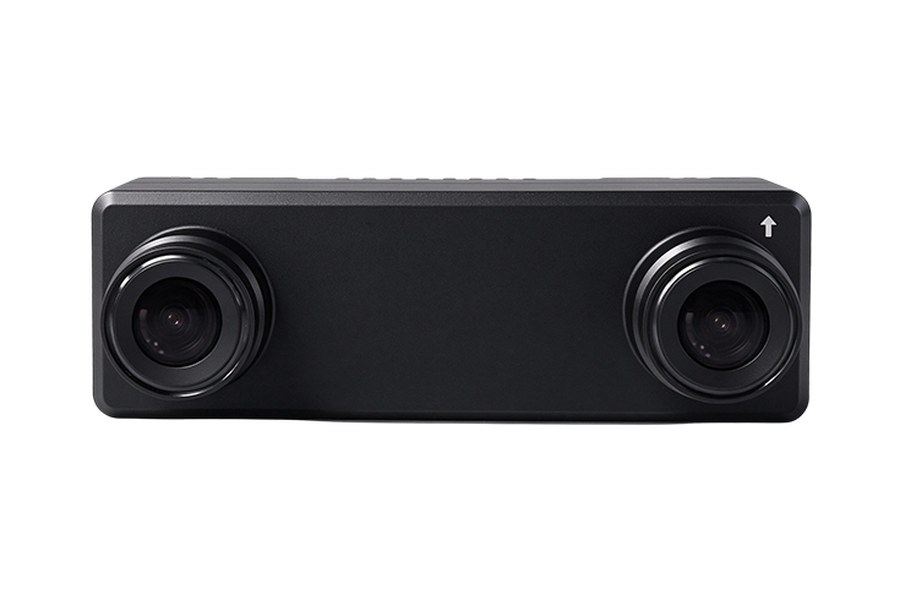
Stereo camera: wide-angle global-shutter cameras with a 400 Hz IMU
Camera not knownIMU not known
- Cameras
- 1 of 2 recorded: 2560 × 1984 at 20 HzMeasured
- Shutter
- GlobalMaker
- Field of view
- Calibrated 154° × 116°Measured
140° horizontal (S56D)Maker - Baseline
- One camera in this runMeasured
- IMU
- 400 HzMeasured
- Output
- GMSL2; ROS 1 bag in the recordingMaker
Maker values from the SENSING product pages (S56D, S56x), read 2026-11-27 · 1 recording, 58 s
Demo and values
Section titled “Demo and values”Wide-angle stereo camera from SENSING TECH with two 5 MP global-shutter sensors and a 6-axis IMU, on a GMSL2 link. One recording from the maker in front of a lit AprilGrid in a dark room, with one of the two cameras, solved as camera + IMU. These are first results; the stereo pair is not calibrated yet.
Reprojection is how far, in pixels, the detected corners lie from where the solve puts them. td is the camera–IMU time offset, and the lever arm is the camera–IMU position offset.
First results from one recording. There is no second recording, no maker calibration and no round-trip check to compare with yet.
Calibration process
Section titled “Calibration process”The path of the rig around the board, as MVIS solved it. To explore it:
- Press Play or drag the bar to follow the path.
- Use the view buttons to change the view.
- Pick a camera card to put that camera on the frustum, the pyramid that shows its view.
Each card draws the board from the solved pose, with the corners MVIS detected. We publish no camera images.
Solved rig
Section titled “Solved rig”The solved rig in 3D, to scale. Tap a sensor to see its values. In full screen you can rotate and zoom. Grid squares are 20 mm.
To scale, from above and the front
| Camera | Lever x, y, z (mm) | Distance (mm) | log(R) (rad) | td (ms) | Field of view |
|---|---|---|---|---|---|
| cam0 | +0.9, +16.1, −17.3 | 23.7 | [−2.215, +2.220, −0.009] | +3.91 | 154° × 116° |
Solved by MVIS. Lever arms (camera–IMU position offsets) are in the IMU frame. Rotation is log(R), camera in the IMU frame.
Detailed results
Section titled “Detailed results”Lens Calibrated field of view
Calibrated field of view, horizontal × vertical. cam0: 154° × 116°, corners reach 88° from the axis
cam0
We read these from the calibrated lens fit at the image edges, through the principal point (where the optical axis meets the image). ~ marks an axis past where the corners reached, so the fit is extrapolated there. Past the fit means an edge lies beyond where the fit holds, so we give no value.
IMU Gyro–accel time offset t_ga +3.11 ms
Each bar shows a scale as its deviation from 1. IMU model: calyx. t_ga, the time offset between the gyroscope and accelerometer channels: +3.11 ± 0.08 ms.
Timing cam0 td +3.91 ms
The time offsets, to scale. td is the camera–IMU time offset, with t_imu = t_cam + td.
Full results Every solved parameter
Rotation is log(R) in rad, camera in the IMU frame.
| Parameter | MVIS |
|---|---|
| cam0 | |
| fx px | 1022.47 |
| fy px | 1022.34 |
| cx px | 1279.08 |
| cy px | 985.15 |
| k1 | −0.04387 |
| k2 | 0.00872 |
| k3 | −0.00300 |
| k4 | 0.00010 |
| Lever x mm | +0.90 |
| Lever y mm | +16.14 |
| Lever z mm | −17.33 |
| log(R) rad | [−2.2152, +2.2199, −0.0094] |
| td ms | +3.913 |
| Reprojection px | 0.422 |
| IMU | |
| t_ga ms | +3.11 ± 0.08 |
Limits
Section titled “Limits”- First results from one recording. There is no second recording, no maker calibration and no round-trip check to compare with yet.
- The recording holds one of the two cameras, so the stereo extrinsics and the baseline are not calibrated.
- The tag size, 88 mm, is assumed: the maker has not given the board size. The metric scale from the IMU agrees with it to about 0.1 %. It scales the lever arm.
- The images are JPEG-compressed, which can shift detected corners slightly.
- The recording site is assumed to be Shenzhen, the maker's city.
Specifications
Section titled “Specifications”| Published by the maker | |
|---|---|
| Maker | SENSING TECH (Shenzhen) |
| Cameras | 2 × 5 MP global shutter, 2560 × 1984 at 30 fps |
| Shutter | Global |
| Variant | Not stated by the maker. Likely the S56D: its listing is the 2560 × 1984 RGB model (the S56x also has 2560 × 1984) |
| Lens | Wide angle, 140° horizontal (S56D); 130° or 140° (S56x) |
| IMU chip | Not published |
| Link | GMSL2 |
| Measured in these recordings | |
| Images in the recording | 1 camera, 2560 × 1984 colour at 20 Hz, JPEG |
| IMU | 6-axis, gyro and accelerometer at 400 Hz |
| Calibrated field of view | cam0 154° × 116° |
How it was run
Section titled “How it was run”- Camera with the IMU in one solve. Kannala-Brandt (kb4) fisheye intrinsics seeded from a single-camera solve of the same recording and left free; the camera time offset, IMU scale and misalignment and the gyro-to-accel offset t_ga estimated. Every board corner is used. IMU noise is the noise measured at rest in the recording times 2.5. Gravity is the local value of Shenzhen, 9.788 m/s². Solved 2026-11-25.
Dataset
Section titled “Dataset”| Recording | 1 recording, 58 s. 1169 frames at 20 Hz, IMU at 400 Hz |
| Format | ROS 1 bag: JPEG images and IMU |
| Board | AprilGrid, 6×6 tags, lit, in a dark room. Tag size 88 mm and spacing 0.3 assumed |
| Data | Calibench-VI community, astra-s56/data/ (access by automatic approval). The maker's ROS1 bag, unchanged. Recorded by SENSING TECH. |
| Configs and results | Calibench-VI community, astra-s56/ (access by automatic approval) |
| Licence | see License |